



Employee appreciation has a direct impact on your bottom line.
Global employee engagement fell to 21% in 2024 — a two-point drop in a single year, according to Gallup. In the US, only 31% of employees are engaged, the lowest level in a decade. Meanwhile, 78% of employees say they would be more productive if they were recognized more frequently. The gap between what employees need and what most companies deliver is wide — and it’s getting wider.
Remote and hybrid work makes it harder to close. According to Pew Research, nearly 80% of employees whose jobs can be done remotely are now working hybrid or fully remote at least part of the time. That shift has a cost. The informal moments of recognition that used to happen naturally — a hallway comment, a quick word after a meeting — don’t exist for distributed teams. Appreciation doesn’t disappear because people stop caring; it disappears because the environment that used to generate it automatically no longer exists. Building it back requires deliberate design.
This guide covers 26 virtual and hybrid employee appreciation ideas — organized by theme, sized for every budget, and built around what actually works for distributed teams. Whether your team is fully remote, hybrid, or spread across time zones, there’s something here you can act on today.
What is virtual employee appreciation?
Virtual employee appreciation means recognizing and celebrating the efforts of remote or hybrid employees through digital tools and online platforms. Done well, it makes distributed workers feel genuinely valued and connected to the company despite the physical distance.
Effective virtual appreciation goes beyond a Slack emoji. It’s intentional, personalized, and consistent — and the difference shows. Teams that build recognition into their daily rhythms don’t just feel better; they perform better, retain longer, and build the kind of culture that’s genuinely hard to replicate. For distributed teams, that doesn’t happen by accident. It has to be built in.
How do you show appreciation to employees virtually?
62% of employees describe themselves as disengaged — not burned out, not quitting, just going through the motions. In most cases, recognition is happening. It’s just not landing. These five principles are what make the difference.
- Be specific. Vague recognition (“great job!”) fades fast. Name the behavior, the project, or the impact.
- Be public. Private recognition feels good; public recognition builds culture. Use Slack, LinkedIn, and all-hands meetings.
- Be personal. One-size-fits-all appreciation is forgettable. Tailor gestures to the individual wherever possible.
- Be consistent. A once-a-year Employee Appreciation Day matters less than weekly, organic recognition woven into daily work life.
- Be timely. Recognition delivered weeks after an achievement loses its power. Acknowledge great work as close to the moment as possible.
26 unique virtual and hybrid employee appreciation ideas
Recognition & Visibility
Public acknowledgment that works across time zones
1. Peer recognition programs
Create a structured program where employees nominate and recognize their colleagues — not just top-down from management, but laterally across the team.
Why it works: Peer recognition is often more meaningful than manager recognition because it comes from the people employees work alongside every day. It also scales appreciation across the organization without depending entirely on managers’ bandwidth.
How to implement it: GoProfiles makes peer recognition seamless with custom bravo badges, a public recognition feed, and integrations into Slack and Teams. Establish clear norms: what kinds of behaviors deserve a shout-out, how often people should participate, and whether there’s a leaderboard tied to rewards.
Budget: Free to premium tiers; GoProfiles includes peer recognition in its core platform.
2. Recognition in communication channels
Build recognition directly into the tools your team already uses every day — Slack, Microsoft Teams, or whatever your communication hub is. Don’t ask people to go to a separate platform; meet them where they are.
Why it works: A Slack message creates a moment; a persistent recognition feed creates a record. Pairing both means recognition is visible when it happens and searchable long after — a contribution history new hires can browse, managers can reference, and employees can point to as evidence of their impact.
How to implement it: GoProfiles integrates directly with Slack and Teams, so recognition happens in the flow of work — but every bravo posted also lives permanently on each employee’s GoProfiles profile. Set a team norm of at least one public recognition post per week to build momentum, and encourage managers to reference the recognition feed during one-on-ones and performance reviews so employees see it treated as a real record, not just a social feed.
Budget: Free with GoProfiles’ basic tier; premium features scale with team size.
3. Employee spotlights
Feature one employee per week or month in your company newsletter, intranet, or Slack channel — highlighting their role, a recent win, and something personal about them outside of work.
Why it works: Being spotlighted tells an employee their work is visible to people beyond their immediate team. It also builds cross-team familiarity in distributed organizations where colleagues rarely meet organically.
How to implement it: Create a simple two-question form employees fill out: “What are you most proud of this quarter?” and “What are you into outside of work?” Pair the answers with a candid photo and a brief intro from their manager. GoProfiles can serve as the living “spotlight” feed employees can browse anytime.
Budget: Free — just requires someone to own it.
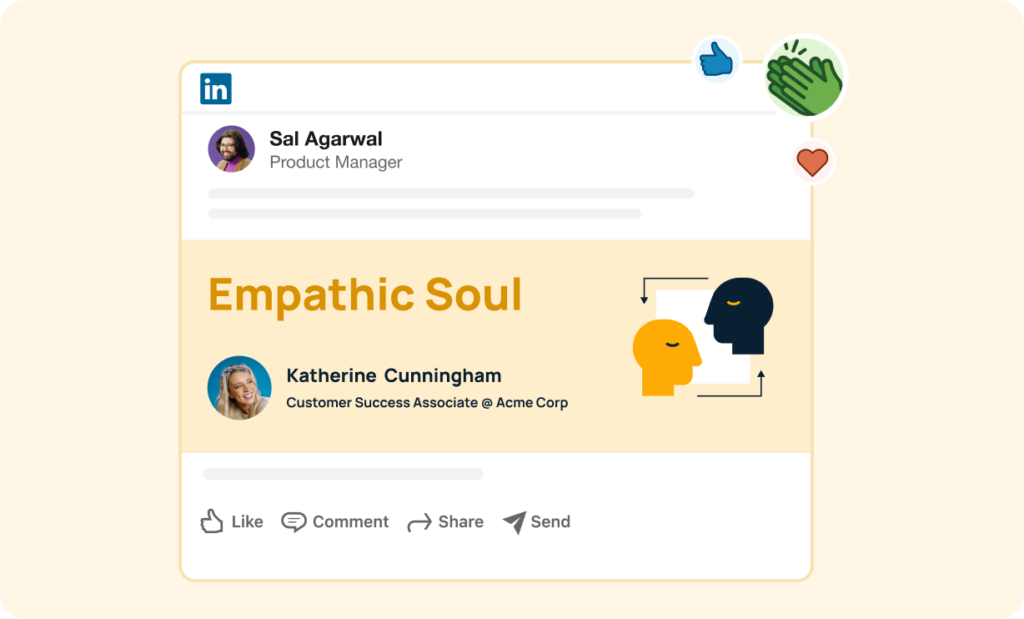
4. Public recognition on LinkedIn
Take employee recognition public by sharing achievements on LinkedIn — tagging the employee, describing their specific contribution, and highlighting the impact on the business or team.
Why it works: Most recognition stays internal. LinkedIn recognition builds an employee’s professional reputation in public — visible to their entire network, often generating comments that compound the original gesture well after it’s posted.
How to implement it: GoProfiles’ peer recognition feature makes it easy to share recognition directly to LinkedIn with one click. Leadership posts carry the most weight — encourage managers and executives to take 10 minutes a week to publicly recognize one team member.
Budget: Free.
5. Employee shout-outs in team meetings
Dedicate the first five minutes of every team meeting — weekly syncs, all-hands, project kickoffs — to explicit shout-outs where anyone can recognize a colleague for something specific they did since the last meeting.
Why it works: Building recognition into an existing ritual removes the friction of doing it separately. It also normalizes gratitude as part of everyday team culture rather than a special occasion — which is where the long-term engagement impact comes from.
How to implement it: The manager or meeting facilitator opens with: “Before we get started, who has a shout-out for someone on the team?” Pause long enough for people to respond — the silence is intentional. Over time, this becomes self-sustaining.
Budget: Free.
Personal & Milestone-Based
Recognition tied to who employees are, not just what they do
6. Personalized video messages
A 60-second video from a manager or senior leader, acknowledging something specific — no script, no editing, just a webcam and genuine recognition. It’s one of the highest-impact appreciation gestures available to any team, and yet almost no one does it consistently.
Why it works: A video from someone in leadership is rare enough to feel genuinely significant. It’s personal in a way a Slack message can’t replicate — employees hear the tone, see the face, feel the sincerity — and that’s difficult to manufacture any other way.
How to implement it: Record it on Loom, drop it in Slack unannounced. No production value needed — just specificity: name the project, the behavior, the impact. The surprise is part of what makes it land. Two or three a month per leader is enough to feel meaningful without losing its rarity.
Budget: Free with tools like Loom.
7. Employee Appreciation Day and Week
Employee Appreciation Day falls on the first Friday of March — mark it on the calendar and plan a single event, or extend it into an entire appreciation week with a different activity or recognition moment each day.
Why it works: A dedicated celebration does something that everyday recognition can’t: it signals that appreciation is worth real time on the calendar. That signal travels further than the event itself.
How to implement it: Build a week-long schedule with a different moment each day: a peer recognition challenge on Monday, leadership video messages on Tuesday, a virtual team lunch on Wednesday, an employee spotlight feature on Thursday, and a virtual awards ceremony to close on Friday. Use GoProfiles to track recognition activity across the week and surface who’s been most active — useful data for the ceremony and beyond.
Budget: Varies; $50–$200 per person for a well-resourced week.
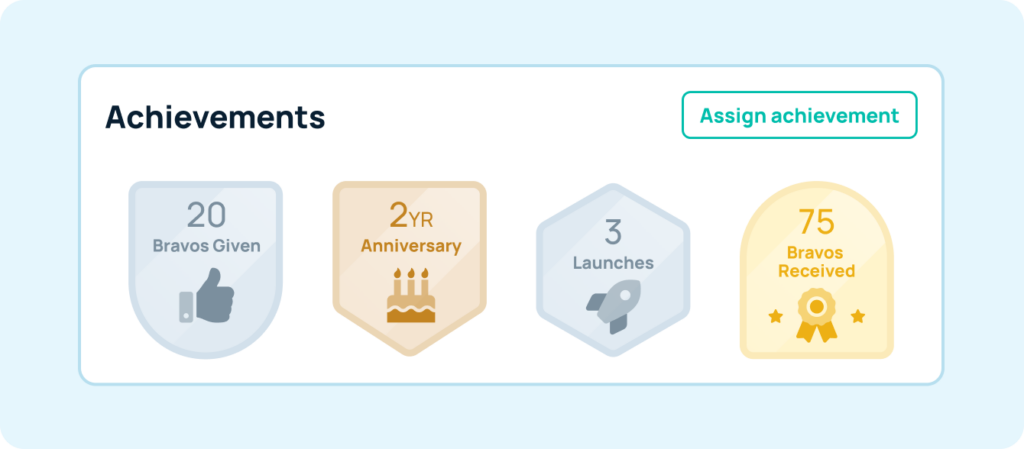
8. Recognition badges and achievement awards
Recognition badges mark the moments that matter most — a product launch, a major client win, a service milestone — giving employees something tangible they can point after the moment has passed.
Why it works: Most recognition is fleeting but a badge persists: on a GoProfiles profile, a LinkedIn page, a permanent record of a specific achievement the employee owns.
How to implement it: With GoProfiles, employees automatically receive custom achievement badges for milestones like work anniversaries, recognition counts, and company values alignment. Make sure each badge is specific — name the achievement, not just the person.
Budget: Free.
9. Virtual awards ceremony
Host a dedicated virtual awards ceremony — quarterly or annually — with real categories, real winners, and real fanfare. Think fun award names, a brief ceremony format, and small prizes for winners.
Why it works: A ceremony elevates recognition to a shared cultural event. The employees who don’t win matter as much as those who do — watching colleagues celebrated publicly reinforces the values the whole organization is meant to live by.
How to implement it: Run nominations in advance so winners reflect the whole team’s perspective, not just management’s. Mix serious categories with fun ones to set the right tone, pair the ceremony with small prizes — gift cards, extra PTO, experience vouchers — and record it for anyone who couldn’t attend live.
Budget: $25–$100 per winner in prizes; the ceremony itself is free.
10. Family inclusion moments
Send a small gift or handwritten card to an employee’s family on a significant milestone — a 5-year work anniversary, a major promotion, or the completion of a particularly grueling project.
Why it works: Every employee has a support system behind their work — a partner who picked up the slack during a product launch, a family that absorbed the stress of a difficult quarter. Acknowledging that signals the company sees the whole person. It’s one of the rarest forms of recognition, which is exactly why it lands so hard.
How to implement it: Keep it simple and personal — a handwritten card from the employee’s manager, a small bouquet, or a gift card to a family restaurant. The gesture doesn’t need to be large; it needs to be specific. Reference the milestone by name in the note (“We know the last six months weren’t easy on your family — thank you for the sacrifice that made this launch possible”). Use GoProfiles employee profiles to track upcoming anniversaries so no milestone is missed.
Budget: $25–$75 per gesture.
Tangible Rewards & Gifts
Appreciation that shows up at their door
11. E-gift cards
Send personalized e-gift cards as a flexible, appreciated token of recognition. The personalization is what separates a forgettable reward from a meaningful one — a coffee card for your avid espresso drinker lands differently than a generic Amazon code.
Why it works: Gift cards respect individual preferences and give employees the agency to choose how they want to be rewarded. They’re also instant — no shipping lag, no sizing issues.
How to implement it: Use GoProfiles for employee rewards. When an employee gives recognition to a coworker, they can also award points redeemable for hundreds of e-gift card options. This ties recognition to reward automatically, reinforcing the behavior you want to encourage.
Budget: $10–$100+ per person, scalable to any budget.
12. Personalized care packages
Send curated physical packages to employees’ homes — snacks, branded merchandise, hobby items, or wellness products — tailored to who they actually are rather than a generic company kit.
Why it works: A physical gift in the mail creates a moment that digital recognition simply can’t. It signals that someone took real time to think about them as a person, not just as a role on an org chart.
How to implement it: Use GoProfiles employee profiles to look up each person’s hobbies, favorite snacks, and interests before assembling a package. Platforms like Caroo or Snappy simplify logistics for large teams. For a personal touch, include a handwritten card or a note from their direct manager.
Budget: $40–$150 per person.
13. Lifestyle subscriptions
Gift employees a subscription to a service that fits their life outside of work — Spotify, Audible, Calm, Headspace, MasterClass, a meal kit service, or a streaming platform — personalized to who they actually are.
Why it works: Most appreciation happens once. A lifestyle subscription happens every month — a recurring reminder that the company sees the employee as a full person, not just a role. The perceived value also tends to far exceed the actual cost: a $12 Spotify subscription feels more personal than a $15 gift card.
How to implement it: Use GoProfiles employee profiles to identify each employee’s interests before choosing a subscription — a cooking enthusiast gets a meal kit, an avid reader gets Audible, someone focused on wellness gets Headspace. For teams at scale, platforms like Tremendous or Giftogram let employees choose their own subscription from a curated list. Always pair the gift with a note that names the specific reason — the subscription signals thoughtfulness, but the note is what makes it personal.
Budget: $10–$25 per person per month.
14. Virtual learning opportunities
Offer employees access to online courses, webinars, or workshops — either as a budget allowance they control or as curated programming tied to their growth goals.
Why it works: Investing in someone’s career development is one of the most powerful forms of appreciation. It signals long-term belief in the person, not just gratitude for past performance.
How to implement it: An annual stipend of $500–$2,000 — redeemable on Coursera, LinkedIn Learning, MasterClass, or industry conferences — lets employees invest in whatever’s most relevant to their growth. For team-wide learning, a monthly lunch and learn with an internal expert or external speaker builds the habit without the overhead.
Budget: $50–$2,000 per person annually, depending on stipend size.
15. Home office upgrade stipend
Give employees a dedicated budget to upgrade their home workspace with whatever they actually need: an ergonomic chair, a monitor stand, noise-canceling headphones, a better desk lamp, or a keyboard they’ll use every day.
Why it works: Companies spend thousands furnishing physical offices and far less on the spaces where remote employees actually work. A home office stipend closes that gap — and unlike most appreciation gestures, it’s used every day, making it a daily reminder rather than a one-time gesture.
How to implement it: Offer the stipend as an annual or one-time benefit with a simple expense reimbursement process — no lengthy approval chain. Set a clear budget and let employees choose what they need rather than prescribing specific items; the autonomy is part of the appreciation. For new hires, consider including the stipend as part of the onboarding package to make a strong first impression before their first day.
Budget: $50–$200 per person.
Experiences & Social Connection
Building relationships across screens
16. Virtual happy hours
An unstructured video call where everyone is told to “just hang out” rarely works. Virtual happy hours do — when they’re built around a theme, a game, or an activity that gives people something to focus on besides the awkwardness of a grid of faces.
Why it works: Happy hours create informal bonding moments that are hard to foster in async environments. Shared experiences — even virtual ones — build the psychological safety that makes teams more effective.
How to implement it: Schedule them quarterly at minimum — monthly for smaller or closer-knit teams. For the event itself, platforms like Confetti source virtual event kits — wine tastings, mixology classes, paint nights — and ship the physical components directly to employees before the event.
Budget: $30–$80 per person with kits; free if self-hosted.
17. Virtual lunches
A meal credit and a no-agenda video call is one of the simplest appreciation gestures that actually feels personal. It works one-on-one as a manager check-in or across a small group — either way, it pairs a tangible reward with the kind of informal face time that remote teams rarely get.
Why it works: Meals are one of the most universal bonding rituals. Replicating that experience virtually creates warmth and informality that formal meetings don’t.
How to implement it: Send meal delivery credits in advance so employees can order what they actually want — Uber Eats, DoorDash, or a local restaurant gift card. For international teams, a global gifting platform like Giftogram handles the logistics. Keep the call agenda-free; the moment it becomes a working lunch, it stops being appreciation.
Budget: $15–$40 per person.
18. Virtual team building activities
Where happy hours are conversation-first, team-building activities are activity-first — online escape rooms, trivia nights, cooking classes, drawing games. The structure does the social work so people don’t have to.
Why it works: Structured activities lower the social awkwardness of virtual interaction. People who might go quiet in a free-form video call will engage readily when there’s a shared challenge or game to focus on.
How to implement it: Schedule these as a dedicated event, not an add-on to a regular meeting — the context matters. Let’s Roam and Jackbox Games both offer ready-to-run virtual experiences; for trivia, Kahoot or Mentimeter let you build custom rounds with company-specific questions.
Budget: $10–$40 per person depending on the experience.
19. Virtual coffee breaks
Virtual coffee chats are 15–20 minutes, no agenda, no work talk — just two people getting to know each other. Run them as manager check-ins or randomly pair teammates across the team.
Why it works: Remote workers miss the hallway conversations that used to happen organically. Brief, informal connection turns out to matter more than most teams realize — even a 15-minute chat with no agenda measurably improves job satisfaction and team cohesion.
How to implement it: Donut (a Slack app) automatically pairs employees and schedules chats without any coordination overhead. For manager-driven coffees, one blocked 20-minute slot per week, rotated through direct reports monthly, is enough.
Budget: Free.
20. Online hobby clubs and interest groups
Create opt-in virtual spaces where employees with shared interests can connect — a book club, a running group, a gaming server, a cooking community — completely separate from work topics.
Why it works: Shared interests are one of the fastest ways to build authentic relationships across organizational silos. Hobby groups surface commonalities between people who might never collaborate on a project but become genuine friends, strengthening the overall fabric of your culture.
How to implement it: GoProfiles employee groups make it easy to create and manage interest-based communities within your company directory. Start with a few seed groups (fitness, books, parents) and let employees create their own from there. A small budget for group activities (a book purchase, a virtual class) goes a long way.
Budget: $5–$20 per person per quarter for activities.
Hybrid Equity
Closing the gap between remote and in-office recognition
21. Make hybrid recognition visible both ways
Make every recognition moment visible to everyone, regardless of where it happened. In-person recognition goes into a shared channel immediately after the meeting. Digital recognition for remote employees gets surfaced at the next in-person gathering.
Why it works: Recognition that stays siloed — digital for remote, verbal for in-office — creates two separate cultures within the same team. Making every recognition moment visible to everyone reinforces that the standard of appreciation is the same regardless of location.
How to implement it: Post in-person recognition to the team channel the same day — before the moment fades. GoProfiles’ recognition feed gives everyone a shared, persistent record of team appreciation regardless of where they were when it happened.
Budget: Free.
22. Equal access to perks
If you’re offering in-office perks — catered lunches, on-site events, game rooms — create a direct equivalent budget for remote employees: a meal delivery credit, a coworking stipend, or a home office upgrade fund.
Why it works: When in-office employees receive perks that remote employees don’t, it sends a message that no company intends to send: that there are two classes of employee. That perception is hard to walk back once it takes hold.
How to implement it: Audit current in-office perks, assign a dollar equivalent, and distribute it as a quarterly stipend via GoProfiles Rewards or a direct expense policy. Then tell remote employees explicitly — the parity only lands if people know it exists.
Budget: Match whatever in-office perks cost per person.
23. Hybrid team appreciation events
A hybrid event isn’t an in-person event with a Zoom link. It’s an event that works equally well from anywhere — designed that way from the start, not retrofitted. Cooking classes with kits shipped to remote employees. Trivia that runs the same on a laptop as in a conference room. The test: if you removed the office entirely, would remote attendees still have a complete experience?
Why it works: Events designed for one format and then streamed to the other create a first-class/second-class experience. The fix isn’t a better stream — it’s a different starting point: design for remote first, then build the in-person layer around it.
How to implement it: Start with the remote experience and build the in-person layer around it — not the other way around. Platforms like Hopin or Airmeet handle both formats in one interface. Run a full technical test before the event; a buffering stream is the fastest way to lose remote employees before the event even starts.
Budget: $30–$100 per person depending on the event type.
24. Manager check-ins calibrated to the individual
Hybrid managers tend to build stronger relationships with whoever they see most — not because they mean to, but because proximity creates opportunity. The fix is a deliberate cadence of one-on-one calls with remote direct reports, with no work agenda, just a genuine check-in.
Why it works: Proximity bias is mostly unconscious, which is why awareness alone doesn’t fix it. Structure does — a standing calendar commitment that connects remote reports with their manager as frequently as in-office ones.
How to implement it: One 30-minute call per month per remote direct report, kept separate from any work check-in. Use GoProfiles employee profiles to prep — their interests, recent wins, and upcoming milestones give the conversation a personal anchor. The goal: no remote employee goes more than 30 days without a direct, non-work connection with their manager.
Budget: Free.
25. Virtual mentorship programs
Launch a structured virtual mentorship program pairing employees with senior leaders or experienced peers across different teams — with guided conversation topics, a defined time commitment, and a clear enrollment process.
Why it works: Mentorship is one of the most meaningful investments a company can make in an employee’s long-term growth. For remote employees, it also replaces something specific: the informal access to senior leaders that in-office employees accumulate without trying.
How to implement it: Define a 3- or 6-month structure with biweekly 30-minute calls. Give both sides a simple conversation guide — goals, challenges, career questions — so neither has to figure out the agenda. Platforms like Together or Mentorloop handle matching and scheduling. Announce it broadly: the way a program is positioned determines who signs up for it.
Budget: $10–$30 per participant per month for platforms; largely free for self-run programs.
26. Virtual offsite
Plan a dedicated virtual offsite — a full or half day set aside from normal work — combining team-building, strategic discussion, and social time, intentionally designed to replicate the energy and connection of an in-person retreat.
Why it works: A virtual offsite signals that the team’s culture and cohesion are worth dedicated calendar time. It also creates a shared experience that remote employees can point to — the equivalent of the stories in-office teams tell about their last offsite trip — building the kind of team identity that sustains morale long after the event ends.
How to implement it: Structure the day in thirds: one-third team building, one-third strategic discussion, one-third unstructured social time. Hopin and Airmeet both handle multi-session virtual events. Send a physical kit — snacks, a notebook — in advance; it’s the detail that makes it feel like an event rather than a long Zoom call.
Budget: $50–$200 per person.
How to build a sustainable recognition program
The ideas in this guide work. What makes them work consistently is the system behind them — because one-off gestures, however well-intentioned, don’t move engagement the way structural recognition does. Here’s how to build a program that lasts.
Frequency beats magnitude. Small, specific recognition delivered weekly outperforms a large annual award almost every time. The goal is to make appreciation a daily habit at the team level, not a quarterly event on the HR calendar.
Combine peer-to-peer and manager-to-employee recognition. Programs that rely solely on managers to drive recognition create bottlenecks and blind spots. Peer recognition distributes the work across the team and surfaces contributions that managers often miss. GoProfiles supports both in a single platform, with Slack and Teams integration so recognition stays in the flow of work. See how one high-growth AI startup built this into their culture.
Tailor recognition to the individual. Some employees want a public shout-out in all-hands. Others would rather receive a private note. Some are motivated by monetary rewards; others value time, experiences, or professional development. GoProfiles employee profiles surface these preferences so recognition can be personalized at scale rather than defaulting to one-size-fits-all.
Automate the milestones so nothing gets missed. Work anniversaries, birthdays, and promotion dates are high-impact recognition moments that are also easy to forget. GoProfiles Celebrations surfaces these automatically, giving managers the prompt and the context to act before the moment passes — not a reminder to recognize someone, but a reason to.
Measure what matters. Track recognition frequency per employee, participation rates in recognition programs, eNPS scores over time, and voluntary turnover. GoProfiles analytics show which employees and teams are receiving recognition and which aren’t — so HR can address gaps before disengagement becomes attrition.
Avoid the most common mistakes. Vague praise, delayed recognition, and programs that run once a year all send the same message: that appreciation is performative rather than genuine. The fix is the same in every case — make recognition specific, timely, and structural, not episodic.
Start with the free ideas — shout-outs, peer recognition, personalized video messages — and layer in more invested programs as the culture matures. Employees who are routinely recognized are 2.7x more engaged. Organizations with formal recognition programs see 14% greater productivity and performance. With global engagement at a multi-year low, the companies that get this right won’t just have happier teams — they’ll have a measurable edge.
For a deeper look at building a recognition program from the ground up, see GoProfiles’ guide to modern employee recognition and rewards for HR leaders.
GoProfiles gives teams the structure for consistent recognition — not just on Employee Appreciation Day. See it in action.
Build a culture of connection and recognition with GoProfiles
Schedule a demo
Frequently Asked Questions: Virtual and Hybrid Employee Appreciation
The most effective virtual rewards combine recognition with a tangible element — an e-gift card, a care package, or an experience. The personalization matters more than the dollar amount: a $20 gift card to someone’s actual coffee shop beats a $50 generic Amazon card. Tools like GoProfiles streamline the process by tying peer recognition to a points-based rewards system that employees can redeem on their own terms.
Consistent, specific, and public recognition is the foundation. Beyond that: invest in their professional development (learning stipends, mentorship), respect the work-life boundary, and make sure they have equal access to perks that in-office employees enjoy. Regular one-on-one check-ins from their manager — with appreciation built in, not just status updates — are the single highest-leverage thing most organizations are underinvesting in. Leadership sets the tone: when executives visibly recognize employees in public channels and all-hands meetings, it signals that appreciation is a real company value.
The highest-ROI free or low-cost ideas: dedicated shout-out time in every team meeting, peer recognition programs in Slack, personalized video messages from leadership, employee spotlights in newsletters, and virtual coffee chats. These don’t require budget and create outsized engagement impact when done consistently.
Weekly at the team level — shout-outs in meetings, peer recognition in Slack. Monthly at the individual level — a spotlight, a personalized message, a small reward tied to something specific. Major milestones on top of that, not instead of it.
The information is already there — in HR platforms, employee profiles, casual conversations. GoProfiles surfaces it in one place so personalization doesn’t require research, just attention.
GoProfiles is the anchor — recognition, rewards, and employee profile data in one platform. For day-to-day recognition, Slack or Microsoft Teams. For public professional acknowledgment, LinkedIn. Donut for automated coffee pairings, Confetti or Let’s Roam for virtual events, Loom for video messages, Together or Mentorloop for mentorship.
The metrics that matter most are the ones that show recognition is actually reaching people: participation rates in recognition programs, recognition frequency per employee, eNPS scores, and voluntary turnover. GoProfiles analytics surface recognition activity, trends, and gaps — giving HR teams the data to intervene before disengagement becomes attrition.