



Most organizations that struggle with remote collaboration reach for the same solution: another tool. A new project management platform. A shinier video conferencing app. A shared drive with better folder structure.
The friction persists anyway.
That’s because remote collaboration doesn’t break at the tool layer — it breaks at the system layer. The invisible infrastructure of norms, shared expectations, and people visibility that makes in-person work feel effortless doesn’t transfer automatically to distributed environments. It has to be designed on purpose.
Tools don’t create that infrastructure. They assume it already exists.
This guide is about building that foundation — the structures, habits, and defaults your team actually runs on. Get those right, and tools amplify them. Skip them, and no tool will fix it.
Why Remote Collaboration Breaks Down
When teammates share physical space, collaboration holds itself together through dozens of small, informal signals. Distance strips all of that away — and replaces it with ambiguity, delays, and duplicated effort.
Here’s how that plays out in practice.
Communication Becomes Fragmented
Remote teams typically spread communication across several channels at once — chat, email, project tools, video calls, shared docs — without clear rules about which conversations belong where. The same topic ends up scattered across all of them.
A decision gets made in Slack. The rationale lives in an email thread. The outcome gets documented — eventually — in a project tool that half the team checks irregularly. When someone needs context two weeks later, they either interrupt a colleague or piece together an incomplete picture on their own.
The problem isn’t the number of channels. It’s the absence of norms for using them.
Knowledge Gets Trapped in Silos
In remote environments, institutional knowledge lives in people’s heads or in threads that quickly become unsearchable. Decisions go undocumented. Workarounds get passed around informally. Onboarding a new hire means interrupting five different people because nothing has been written down.
The result: the same questions get asked repeatedly, the same mistakes get made twice, and the fastest path to an answer is always to ping whoever seems most likely to know.
Visibility Drops Across People and Projects
One of the most underrated problems in remote work is that people can’t find each other — not literally, but in terms of knowing who owns what, who has relevant expertise, and where a project actually stands.
In an office, that awareness builds naturally. In a distributed team, it has to be created deliberately. When it isn’t, the right people never get connected to the right problems.
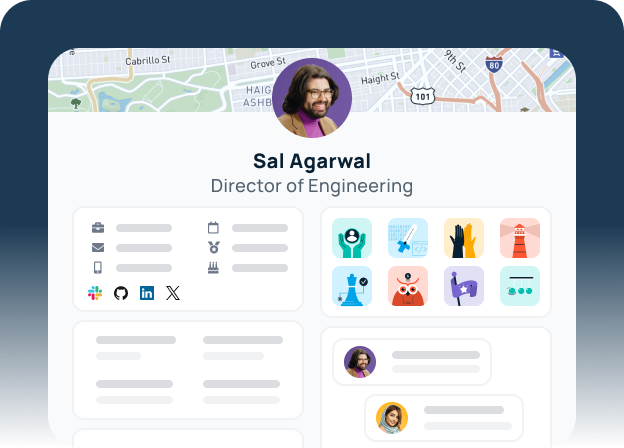
GoProfiles is built for exactly this. By making roles, expertise, and team context searchable across the organization, it gives distributed teams the ambient awareness that office environments produce passively — so finding the right person takes a search, not a chain of introductions.
Start With Clear Collaboration Norms
The fastest way to improve remote team collaboration isn’t a new tool — it’s explicit agreements about how the team communicates. Most remote teams operate on unspoken assumptions that differ from person to person. Making those assumptions explicit is one of the highest-leverage changes a team can make.
Define Which Channels Serve Which Purpose
Every remote team needs a shared understanding of what kind of communication belongs where:
- Chat: Quick questions, informal coordination, social conversation. Not for decisions or documentation.
- Project tools: Task assignments, status updates, project-level context. Not for discussions that belong in docs.
- Documents: Decisions, processes, reference material — anything that needs to last. Not for real-time coordination.
- Video calls: Complex problem-solving, sensitive conversations, relationship-building. Not for updates that could be async.
When everyone knows where things live, the cognitive cost of collaboration drops significantly.
Document Decisions, Not Just Discussions
Meetings and Slack threads capture process. Decisions need to be captured separately. A lightweight decision log — what was decided, why, and what was considered and rejected — prevents an enormous amount of re-litigation down the line.
This isn’t about bureaucracy. It’s about building a shared memory that doesn’t depend on any one person being around to remember — so that information lives in the system, not in someone’s inbox.
Build for Async First
Distributed work is asynchronous. Teams that design around that reality — rather than treating async as a fallback when scheduling gets hard — gain focus, flexibility, and the ability to collaborate across time zones without anyone losing sleep.
Replace Status Meetings With Written Updates
The weekly status meeting is one of the most expensive and least valuable rituals in remote work. When its primary purpose is information sharing rather than decision-making, a short written update does the job better: what I worked on, what I’m working on, what’s blocked.
Written updates are searchable, don’t require everyone to be available at the same time, and free up synchronous time for work that actually benefits from it.
Use Templates for Recurring Work
When a teammate has to figure out what format to use every time they write a project brief, a handoff note, or an onboarding doc, that overhead accumulates into friction. Templates solve this. A simple brief format, a standard handoff structure, a consistent update template — these don’t constrain creativity. They reduce the effort required to communicate clearly, which means more communication actually happens.
Make Documentation Searchable
Documentation only provides value if people can find it. Invest in structure that reflects how people actually look for information. The test is simple: can a new teammate find an answer independently? If not, the documentation system needs work — and so does the people directory behind it.
Improve People Visibility Across the Organization
One of the most overlooked drivers of remote collaboration friction is the difficulty of finding the right person. In a distributed organization, knowing who to ask — and feeling confident enough to ask them — is a capability that has to be built.
Make Roles and Expertise Easy to Discover
Most remote organizations have a team directory. Few have one that’s actually useful for collaboration. A list of names, titles, and email addresses doesn’t tell a teammate what someone works on, what expertise they’ve developed, or what they currently own.
GoProfiles is built for this gap. Employee profiles that surface working context — current projects, areas of expertise, what someone owns — transform a directory into a collaboration tool. When teammates can find the right person quickly, they spend less time waiting for introductions and more time doing the work.
Reduce Dependency on Managers as Routers
In organizations where people visibility is low, managers become information brokers by default. Teammates route questions through them because they’re the only ones who know who does what. It’s slow, it creates bottlenecks, and it’s not a good use of anyone’s time.
Better people visibility breaks this pattern. When anyone can independently identify who owns a domain or who has relevant expertise, they can go directly to that person. Cross-functional problem-solving speeds up. Managers can focus on work that actually requires them.
GoProfiles makes this possible at scale — so as organizations grow, people can still find each other without everything routing through the org chart.
Support Remote Onboarding With Org Context
New hires in remote environments often spend their first weeks trying to map an organization that no one has explicitly described. GoProfiles shortens that curve — a searchable picture of who owns what, across teams, roles, and functions, lets new hires orient themselves, ask better questions, and contribute sooner.
Strengthen Trust and Connection Deliberately
Trust is the foundation that makes everything else on this list actually work. In an office, it builds gradually through small daily interactions. Remote teams don’t have those by default. It has to be built on purpose.
Create Lightweight Rituals for Team Connection
Connection rituals don’t need to be elaborate. A brief check-in at the start of a weekly meeting gives teammates a window into each other’s lives that Slack threads don’t provide. Onboarding buddy programs answer the questions that don’t show up in documentation. Cross-functional introductions — made easier when GoProfiles surfaces shared interests and complementary expertise — help people form connections outside their immediate team.
Make Recognition More Visible
In an office, good work tends to get noticed. Remote work doesn’t have the same ambient visibility. Important contributions can go completely unnoticed unless someone explicitly calls them out.
Regular, public recognition practices — such as a dedicated channel for peer recognition — ensure that doing excellent work in a distributed environment leads to the same acknowledgment it would receive in person.
Don’t Set It and Forget It
Remote collaboration systems atrophy. Norms that worked for ten people don’t scale to forty. Habits a founding team built together may never have been taught to newer hires. Treat your collaboration norms like any other operational process.
Ask Where Work Gets Stuck
The most valuable audit question is also the most direct: where does work slow down? Common answers include unclear ownership, missing documentation, and slow handoffs. These are symptoms of system problems, not individual failures — and treating them that way leads to solutions that actually stick.
A useful proxy: can your teammates find what they need without asking someone? Ask a new hire to locate an answer independently. Ask an experienced teammate how they’d find expertise they don’t personally have. The friction those exercises surface is your improvement list. GoProfiles addresses this directly — making people, roles, and expertise searchable so the answer to “who should I talk to?” is never more than a search away.
Clarity Is the Strategy
Improving remote team collaboration doesn’t come from finding the right tool. It comes from building a clearer system — explicit norms, accessible documentation, and people visibility that lets teammates find and help each other.
That last piece is where most organizations fall short, and where GoProfiles makes the biggest difference. When roles, expertise, and team context are visible and searchable, distributed teams stop relying on luck to connect the right people to the right problems. Collaboration becomes intentional instead of accidental.
The question isn’t whether your remote team can work well together. It’s whether you’ve built the system that makes it easy.
Ready to bring clarity and context to your distributed team? Explore GoProfiles and learn how to make people visibility a foundation of your organization.
Build a culture of connection and recognition with GoProfiles
Schedule a demo