



For years, enterprise AI transformation followed a familiar playbook: IT selects the tools, engineering integrates them, and employees are told what’s now “available.”
But as organizations move deeper into the AI era, that model is starting to break.
The companies seeing real adoption—and real ROI—are shifting ownership of AI transformation away from IT alone and toward a new kind of leadership model: the Chief People and AI Officer function, often sitting inside HR, People, or cross-functional leadership teams.
It’s a subtle but important shift. And it’s redefining what “AI readiness” actually means.
The IT-Led AI Model Is Hitting Its Ceiling
The traditional approach to enterprise AI enablement is straightforward:
- IT evaluates tools
- Procurement approves vendors
- Engineering integrates systems
- A company-wide rollout email follows
And then… nothing really changes.
As Sarika Lamont of Vidyard observed, this pattern is increasingly common:
AI transformation is often treated as a technology rollout. The assumption is that once the tools are in place, behavior will follow.
But behavior rarely follows.
Instead:
- Usage stays superficial
- Employees treat AI like “a slightly better search engine”
- ROI remains unclear
- Six months later, leadership questions adoption
The problem isn’t capability. It’s activation.
The Real Problem: AI Isn’t a Tech Rollout—It’s a Behavior Shift
The emerging consensus among modern people leaders is simple:
AI transformation is not a tooling problem. It’s a behavior change problem.
And behavior change doesn’t live in infrastructure teams.
It lives in:
- Manager behavior
- Psychological safety
- Learning culture
- Incentives and performance systems
- Day-to-day workflows
As Sarika Lamont, Chief People Officer at Vidyard, highlights, the real blockers aren’t technical at all:
- The manager who doesn’t model AI usage, signaling it’s optional
- The employee who is unsure if AI will replace their role
- The leader who approved the rollout but never uses the tool
These are not system failures.
They are human systems failing to adapt.
Why HR Is Emerging as the AI Transformation Owner
The idea that HR or People teams would lead AI transformation still surprises many executives.
As Sarika Lamont shared in a recent reflection, people often react with genuine curiosity when they learn HR is driving AI strategy:
“The HR person? Interesting.”
That reaction reveals the underlying assumption: AI is still viewed primarily as a technical initiative.
But HR leaders argue something different: AI adoption succeeds or fails based on whether people actually change how they work.
That is fundamentally a People function.
The Rise of the Chief People and AI Officer Mindset
Across forward-thinking organizations, a new leadership pattern is emerging: HR leaders stepping into AI transformation roles—not as tool administrators, but as behavior architects of the enterprise AI era.
Sarika Lamont: AI as behavior change infrastructure
At Vidyard, Sarika Lamont frames AI transformation as a trust and behavior problem. The focus is not just access to tools, but enabling employees to safely experiment, learn, and integrate AI into real workflows.
Her core insight:
If people don’t feel safe changing how they work, they won’t.
Avani Solanki Prabhaker: AI embedded into ways of working
At Atlassian, Avani Solanki Prabhaker, Chief People and AI Officer, represents a broader shift toward embedding AI into how teams collaborate and execute—not as an external tool, but as part of the operating system of work itself.
This reflects a deeper truth: AI adoption isn’t about usage metrics—it’s about workflow redesign.
When AI becomes part of “how work gets done,” adoption stops being a choice.
Brandon Sammut: AI as a distributed capability, not a centralized rollout
At Zapier, Brandon Sammut, Chief People and AI Officer at Zapier, approaches reflects a different but complementary philosophy: AI is not something you deploy from the top down—it is something you enable across a distributed workforce.
In highly automated, workflow-driven environments, AI becomes a multiplier of individual agency. The role of People leadership is to ensure employees can safely and effectively build with it.
The result: AI is not a tool employees use occasionally—it becomes part of how they operate by default.
The Missing Layer in AI Transformation: People + Knowledge Systems
If AI transformation is fundamentally a behavior change problem, then most organizations are missing two critical systems that actually enable that change:
- Who people are and how they work
- Where knowledge lives and how it is accessed
This is where transformation breaks down.
Employees are expected to “use AI,” but:
- They don’t know who the internal experts are
- They can’t easily find trusted knowledge across tools
- And they don’t see AI embedded into daily workflows
This is the gap between AI availability and AI adoption.
The People Layer: Making Behavior Change Visible
A Chief People and AI Officer model only works if organizations understand how work actually gets done within the company.
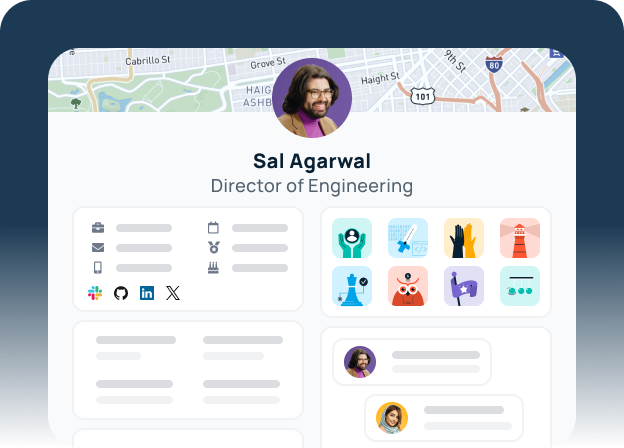
This is where GoProfiles becomes foundational.
In an AI-driven organization, GoProfiles helps teams:
- Understand who does what across the company
- Surface expertise so employees don’t default to guessing or Slack pings
- Reinforce new AI behaviors by making collaboration patterns visible
- Support managers in modeling adoption across teams
Because behavior change doesn’t scale through mandate—it scales through visibility and reinforcement loops.
If AI is going to change how people work, organizations first need clarity on:
who is working, how they work, and where influence actually sits
That is the People layer of AI transformation.
The Knowledge Layer: Making AI Usable in Daily Work
Once behavior is visible, the next challenge is execution.
AI adoption fails when employees still can’t find answers fast enough to change behavior in the moment of work.
This is where GoSearch becomes critical.
GoSearch enables organizations to:
- Unify knowledge across Slack, Notion, Jira, Drive, Confluence, and more
- Turn fragmented information into actionable answers
- Bring AI directly into workflows instead of making it a separate tool
- Reduce dependency on tribal knowledge or repeated questions
In practice, this shifts AI from:
“a tool employees try occasionally”
to:
“the default way work gets done”
And that is the moment behavior actually changes.
AI Transformation Requires a Connected System, Not Isolated Tools
Most companies still treat AI adoption as a tooling rollout problem.
But the organizations getting it right are building something more connected:
- GoLinks → helps people access and share company information faster
- GoProfiles → helps people see each other, understand roles, and reinforce new behaviors
- GoSearch → helps people access knowledge and act on it in real time
Together, they form a system most companies are missing:
the ability to connect who people are with what they need to know at the exact moment work happens.
That connection is what turns AI from an experiment into a habit.
Why This Moment Requires a New Type of Leader
The emerging Chief People and AI Officer is not defined by technical depth alone.
They are defined by:
- Comfort operating across HR, IT, and Engineering
- Ability to translate AI capability into behavior change
- Alignment of AI adoption with business outcomes
- Ownership of enablement, not just access
As Sarika Lamont notes, this is not a role every HR leader is automatically prepared for.
It requires:
- Business fluency
- Cross-functional authority
- Comfort with technical ambiguity
- A direct link between capability building and commercial impact
But where that capability exists, it becomes a powerful organizational advantage.
The Future of AI Transformation Is Organizational, Not Technical
The organizations that successfully transition into the AI era will not be those with the most advanced infrastructure.
They will be the ones where:
- People actually changed how they work
- Managers actively reinforce new behaviors
- Learning is continuous and embedded
- AI becomes part of daily decision-making
This is not a tooling problem.
It is a human system redesign problem.
And increasingly, that system sits at the intersection of People leadership, knowledge access, and AI enablement.
Closing Thought: AI Transformation Needs a Human Operating System
For years, we assumed AI transformation would be led by the teams that build and deploy technology.
But the more organizations scale AI internally, the clearer the pattern becomes:
Technology enables transformation.
But people determine whether it actually happens.
The companies that win in the AI era won’t just deploy better models or tools.
They will build a human operating system where:
- People understand each other and how work gets done
- Knowledge is instantly accessible at the point of need
- Leaders reinforce behavior change, not just tool usage
- And AI becomes embedded in how work is done—not added on top of it
IT can enable AI.
But People + Knowledge systems determine whether it sticks.
And increasingly, that is where the real transformation lives.
Build a culture of connection and recognition with GoProfiles
Schedule a demo