Need a little productivity boost? Join our monthly newsletter and we’ll go/link you to the latest tips and trends in tech!
Key Insight: A two-speed transformation is underway in HR — while some organizations are integrating AI end-to-end across the employee lifecycle, others remain focused on narrow, task-level automation.
The State of AI in HR for 2026
Artificial intelligence is entering a new phase of enterprise adoption within HR. What began as early-stage experimentation has quickly evolved into a strategic operating priority. In 2026, AI is no longer a future-facing initiative — it is actively redefining how HR operates, scales, and delivers value.
However, adoption patterns remain uneven across organizations.
New findings from The State of HR 2026: Tech-First, Strategy-Driven indicate a clear divergence in how organizations are implementing AI across HR functions. While a growing cohort is embedding AI across the employee lifecycle to enable personalization, data-driven decision-making, and organizational agility, many teams remain cautious — limiting AI adoption to discrete administrative or functional use cases.
Together, these patterns signal the emergence of a two-speed HR transformation, where differences in AI maturity are increasingly shaping HR’s ability to drive workforce experience, operational efficiency, and strategic business impact.
The AI Platform Shift in HR — Moving Beyond Automation in 2026
Early AI adoption in HR focused primarily on efficiency gains. Automation reduced manual work across functions such as payroll processing, job description creation, and scheduling. While these improvements remain meaningful, they represent only the first phase of AI value realization.
In 2026, leading organizations are expanding how AI is applied across HR — moving beyond automation toward integrated intelligence and decision support.
Across the market, three clear shifts are emerging:
From task automation to decision augmentation
From isolated tools to integrated platforms
From operational efficiency to strategic enablement
Increasingly, AI is not being deployed as a standalone feature, but as foundational workforce infrastructure — shaping how HR supports leaders, delivers personalized employee experiences, and anticipates future workforce needs.
How Organizations Are Implementing AI in HR
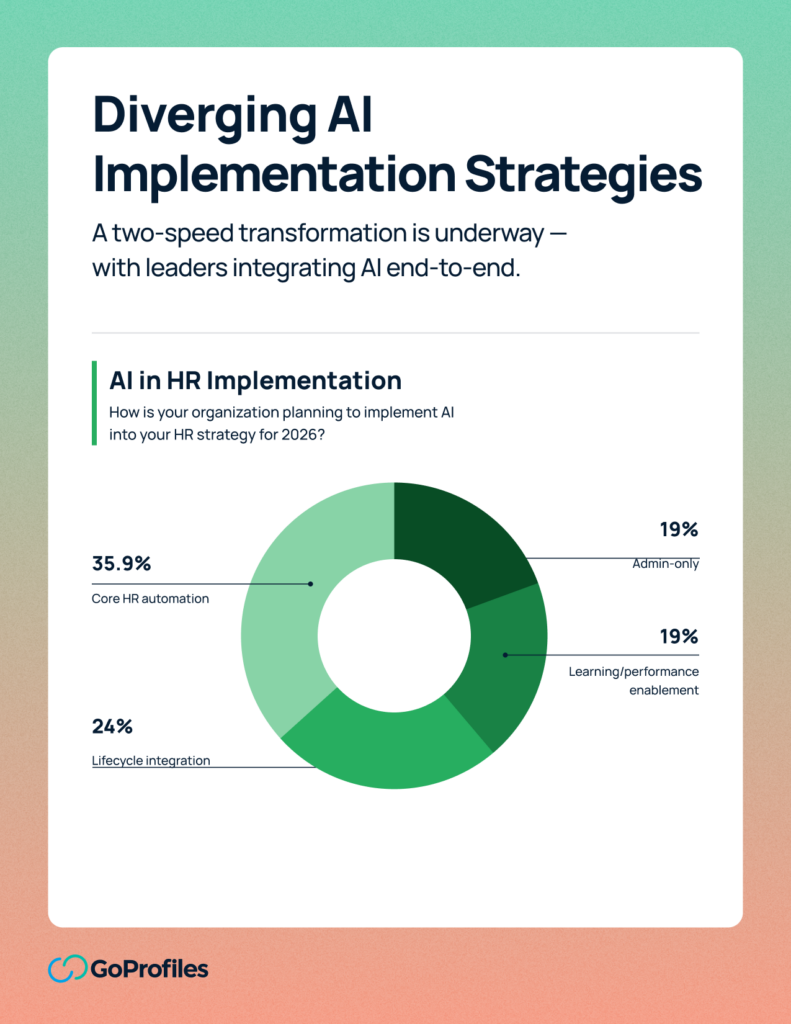
Survey findings indicate that organizations are converging around four primary AI implementation strategies within HR:
Core HR Automation (35.9%) The largest segment is expanding AI-driven automation across core HR processes to improve efficiency, standardization, and operational consistency in day-to-day workflows.
Lifecycle Integration (24.0%) Nearly one quarter of organizations are embedding AI across the employee lifecycle — spanning onboarding, development, engagement, and workforce planning — enabling personalization, faster decision-making, and greater organizational agility.
Admin-Only Use (19.0%) A significant number of organizations continue to limit AI deployment to foundational administrative use cases, such as payroll processing or job description generation, with a primary focus on risk reduction and operational reliability.
Learning & Performance Enablement (19.0%) Another segment is applying AI to learning, performance management, and manager enablement — using data-driven insight to support development and coaching, but without full lifecycle integration.
Key Insight: While nearly one in four organizations is positioning HR as an AI-powered strategic partner through lifecycle integration, the majority are progressing through more incremental, function-specific adoption models.
Why the Divide Exists
A closer look at adoption patterns suggests three primary factors are driving differences in the speed and depth of AI implementation across HR organizations.
Technology Infrastructure
Organizations operating on modern, integrated HR platforms are better positioned to scale AI across data, workflows, and employee experiences. By contrast, fragmented technology environments tend to confine AI to pilots or isolated point solutions — limiting enterprise impact and slowing overall transformation progress.
Leadership Mindset
Leadership perspective plays a significant role in adoption velocity. Forward-looking leaders tend to view AI as a driver of competitive advantage, workforce resilience, and long-term organizational capability. More risk-averse leadership teams often prioritize governance, compliance, and operational control — which can delay broader deployment even when technical capabilities are available.
Workforce Readiness
AI adoption is as much a people transformation as it is a technology shift. Organizations vary widely in how prepared HR teams and people managers are to interpret and act on AI-driven insight. For many, this represents a significant opportunity to strengthen data literacy, build trust in AI systems, and accelerate enterprise change management maturity.
The Risk of Falling Behind
Organizations that limit AI deployment to administrative functions risk widening performance and experience gaps relative to more advanced peers.
Employee expectations are rapidly evolving. Increasingly, workers expect personalized, technology-enabled experiences across the full employee journey — from onboarding and recognition to development and career mobility. When HR organizations are unable to deliver these experiences, engagement, retention, and internal mobility outcomes are likely to decline.
By contrast, organizations that integrate AI across the employee lifecycle are realizing measurable advantages, including:
Greater organizational agility in responding to workforce and market change
More scalable and consistent employee experiences across teams and geographies
Stronger alignment between people strategy and measurable business outcomes
As a result, AI maturity is emerging as a defining factor in overall HR effectiveness and long-term organizational competitiveness.
What This Means for HR Leaders
Transitioning from incremental automation to strategic, enterprise-wide AI adoption requires intentional and sustained leadership focus. As AI becomes embedded into workforce infrastructure, HR leaders must move beyond experimentation toward scalable, outcome-driven deployment.
Research findings suggest three priority areas for HR leadership in 2026 and beyond:
1. Develop a Clear, Business-Aligned AI Roadmap AI investments should be directly tied to business priorities, workforce strategy, and measurable outcomes — rather than standalone experimentation. Organizations with clearly defined AI roadmaps are better positioned to scale adoption, manage risk, and demonstrate value to executive stakeholders.
2. Invest in Trust, Governance, and Responsible AI Responsible AI practices are foundational to long-term adoption. Transparency, data security, bias mitigation, and ethical usage frameworks are critical to building confidence among employees, managers, and executive leadership.
3. Prepare HR Teams for an AI-Enabled Operating Model Upskilling HR teams in data literacy, analytics, and change management is essential to unlocking AI’s full value. Organizations that successfully translate AI insight into action will gain a measurable advantage in workforce performance, experience design, and organizational agility.
As Brandon Sammut, CPO at Zapier, notes:
“AI is moving fast, but the values we lead with—ethics, transparency, and humanity—don’t change.”
—Brandon Sammut, CPO at Zapier
From Automation to Advantage
The emergence of a two-speed AI transformation marks a defining moment for HR organizations.
Enterprises that are integrating AI end-to-end across the employee lifecycle are building faster, more adaptive, and more personalized workforce operating models. Those advancing more cautiously may preserve short-term stability — but risk falling behind as employee expectations, competitive pressures, and technology capabilities continue to accelerate.
In 2026, AI implementation in HR is no longer defined by whether organizations adopt AI — but by how strategically, responsibly, and decisively they choose to lead with it.
See how GoProfiles helps HR teams apply AI across the employee lifecycle — connecting people data, enabling personalization, and supporting more human-centered workforce experiences at enterprise scale.
Build a culture of connection and recognition with GoProfiles