

Key Insight: While leading HR teams are advancing into real-time, strategic analytics, many organizations remain limited to basic or compliance-only reporting — creating a widening analytics maturity gap with measurable consequences for workforce planning and employee experience.
The State of HR Analytics in 2026
HR has spent years building toward a data-driven future. In 2026, that aspiration has become an expectation — the tools are mature, the data is available, and business leaders are demanding more from their people functions. Yet how organizations actually use workforce data varies widely.
New research from The State of HR 2026: Tech-First, Strategy-Driven reveals a clear divide in how organizations approach employee data and workforce analytics. Some HR teams are embedding analytics directly into strategy, using real-time insight to guide decisions around talent, engagement, and workforce design. Others are still focused primarily on reporting for compliance and administration.
This gap in analytics maturity is now one of the most important factors separating high-performing HR functions from the rest.
The HR Analytics Reset
For years, HR analytics meant looking backward. Headcount reports, turnover summaries, and compliance dashboards dominated the landscape. These metrics remain necessary — but they are no longer sufficient.
In 2026, analytics is expected to power outcomes:
- Proactive talent planning instead of reactive hiring
- Personalized employee experiences instead of one-size-fits-all programs
- Predictive insight instead of retrospective reporting
For the most advanced HR teams, workforce analytics has shifted from a reporting function to a strategic capability — one that shapes decisions at every level of the organization.
Where Organizations Fall on the Analytics Maturity Curve
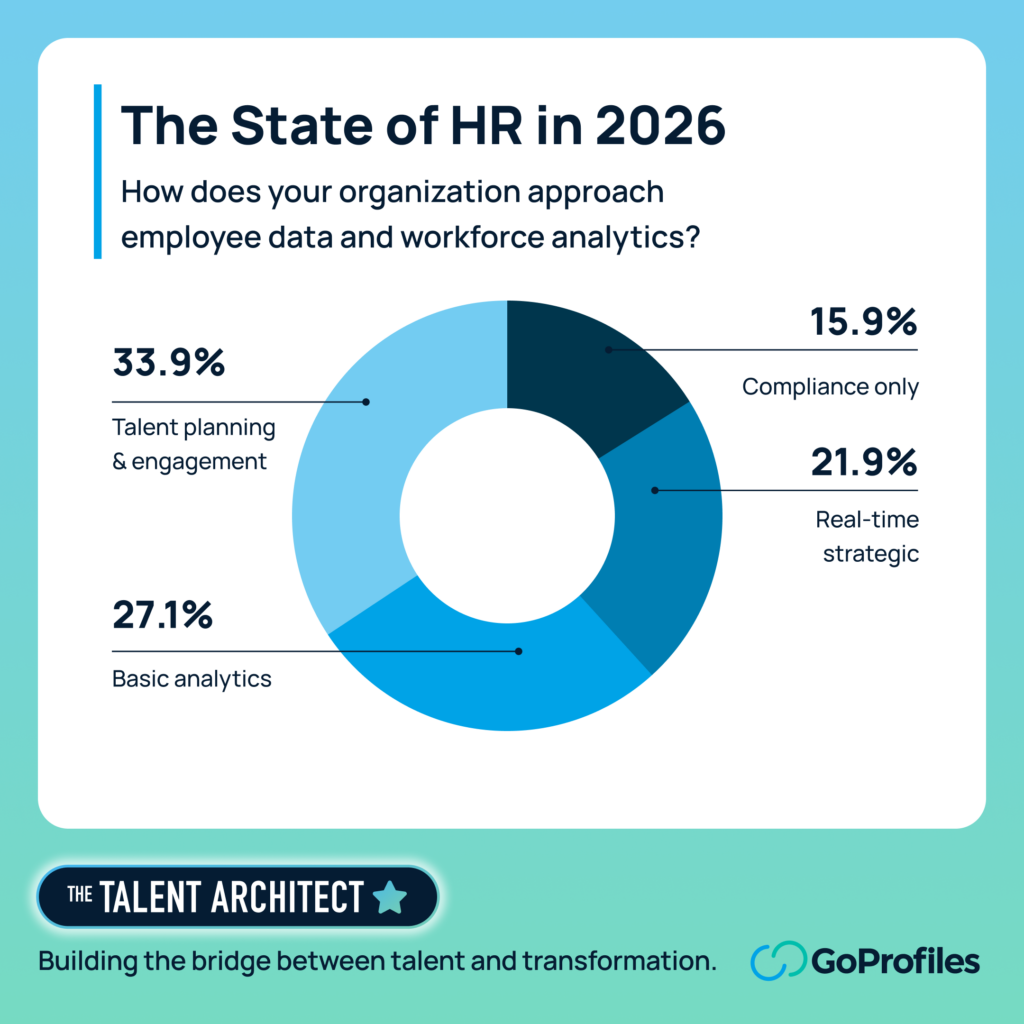
Data from the 2026 State of HR survey reveals four distinct approaches to workforce analytics — each reflecting a different level of organizational maturity.
Talent Planning & Engagement (33.9%) — The largest group uses people data to actively inform decisions around productivity, engagement, and workforce planning. Analytics drives action, not just observation.
Basic Analytics (27.1%) — More than one in four organizations apply analytics at a foundational level, but insights are rarely tied to business goals or strategic outcomes.
Real-Time Strategic Analytics (21.9%) — Roughly one in five organizations use real-time analytics to guide workforce design, anticipate talent needs, and personalize employee experiences at scale.
Compliance-Only Analytics (15.9%) — A smaller — but still significant — group collects workforce data primarily to satisfy regulatory and administrative requirements — and little else.
This divide is significant: while one-third of organizations are advancing analytics as a strategic capability, another third remain anchored at basic or compliance-only levels — with real consequences for workforce performance and employee experience.
Why the Analytics Maturity Gap Persists
The barriers are consistent across organizations — and rarely about technology alone.
1. Fragmented Systems Limit Insight
Many HR teams still operate across disconnected platforms — employee data scattered across HRIS, performance tools, engagement platforms, and spreadsheets. Without integration, analytics remain slow, incomplete, and difficult to trust. Fragmentation turns insight into a manual exercise rather than a real-time capability.
2. Analytics Skills Are Still Catching Up
Advanced analytics requires more than dashboards. It demands fluency in interpretation, storytelling, and applying insight to decisions. Many HR teams are still early in this journey — creating a significant opportunity to expand strategic impact through upskilling and cross-functional partnership.
3. Cultural Mindsets Hold Teams Back
In some organizations, HR data is still viewed as operational rather than strategic. When analytics is viewed as a reporting obligation instead of a decision-making tool, investment slows — regardless of available technology. Shifting this mindset is often the hardest step toward maturity, and the most important one.
What Advanced Analytics Enables
Organizations operating at higher levels of analytics maturity are already seeing measurable impact across the employee lifecycle. Common high-value use cases include:
- Predictive retention models that surface early risk signals and enable proactive engagement before attrition occurs
- Skills mapping and workforce planning that align internal talent with evolving business needs
- Engagement insights that connect recognition, development, and productivity data to performance outcomes
These capabilities allow HR to move from tracking activity to shaping experience — and from reacting to problems to preventing them.
What This Means for HR Leaders
Closing the analytics maturity gap requires more than adding dashboards. It requires a strategic shift in how data is collected, connected, and used across the organization. HR leaders should focus on three priorities.
1. Invest in Integrated People Platforms
Unified systems create a single source of truth for employee data — enabling real-time insight and eliminating manual reporting overhead. Without integration, everything else is harder than it needs to be.
2. Build Analytics Capability Inside HR
Access to data is only half the equation. Upskilling HR teams in interpretation and storytelling — and partnering closely with analytics and business leaders — is what turns raw insight into informed action that influences decisions at the executive level.
3. Tie Analytics to Business and Experience Outcomes
The most effective analytics strategies tie insight directly to retention, productivity, engagement, and performance. When HR can demonstrate that connection clearly, analytics stops being a reporting function and starts being a strategic advantage.
From Reporting to Real-Time Insight
The analytics maturity gap is not a technology problem. It is a strategic one — and the organizations that treat it that way are already pulling ahead.
Organizations that advance into real-time, insight-driven analytics gain a clearer view of their workforce, deliver more personalized employee experiences, and make faster, more confident decisions in an increasingly complex environment. Those still anchored in compliance-only reporting risk falling behind — not just in HR capability, but in overall business performance.
In 2026, the question is no longer whether HR should invest in analytics. It is how quickly teams can evolve from reporting the past to shaping the future.
See how GoProfiles helps HR teams unify people data, surface meaningful insight, and personalize employee experiences at scale. Book a demo today.
Build a culture of connection and recognition with GoProfiles
Schedule a demo