Need a little productivity boost? Join our monthly newsletter and we’ll go/link you to the latest tips and trends in tech!
Key Insight: Two-thirds of HR leaders now identify as Tech Trailblazers — signaling that technology fluency has become the defining capability of strategic HR leadership in 2026.
HR Has a New Kind of Leader
The idea that HR is fundamentally a people function is not wrong — but it is increasingly incomplete. In 2026, the most effective HR leaders are defined not just by their people-first perspective or their operational discipline, but by their ability to harness technology as a strategic lever. The data from State of HR 2026: Tech-First, Strategy-Driven settles the debate: two-thirds of HR leaders now identify as Tech Trailblazers —a margin that changes what HR leadership means.
The report surveyed nearly 400 HR leaders on how they are using technology to elevate HR’s strategic role, strengthen culture, and deliver measurable impact on retention, productivity, and revenue. The answers were clear. AI and advanced analytics have moved from “nice to have” to the primary lever HR leaders are reaching for — to reduce friction, personalize the employee experience, and demonstrate value in terms the business understands.
What the Data Reveals About HR Leadership Styles in 2026
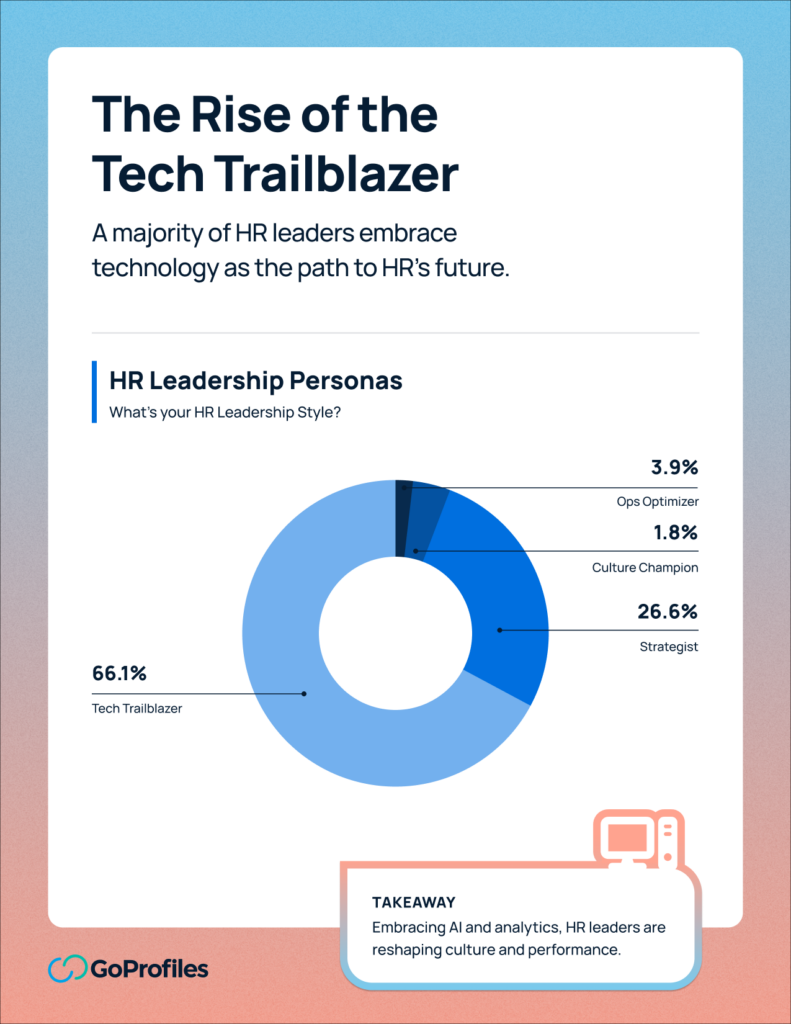
According to the State of HR 2026: Tech-First, Strategy-Driven, five distinct HR leadership personas emerged from the research — each reflecting a different approach to people, technology, and strategy.
Tech Trailblazer (66.1%) — These leaders harness AI, analytics, and digital platforms to drive culture, performance, and workforce strategy. Technology is not a tool for them — it is a competitive advantage.
Strategist (26.6%) — Focused on aligning HR with enterprise priorities, this group uses insight and influence to shape organizational direction from the top down.
Ops Optimizer (3.9%) — These leaders prioritize process efficiency, consistency, and operational excellence — building the infrastructure that keeps HR functioning at scale.
Culture Champion (1.8%) — Anchored in values, belonging, and employee experience, this group treats culture as the primary lever for performance and retention.
Talent Architect (1.6%) — Dedicated to building the workforce of the future — designing the systems, pathways, and pipelines that ensure the right talent is in the right place at the right time.
The data tells a clear story. Two-thirds of HR leaders now see themselves as innovators and technologists — harnessing AI, analytics, and digital platforms to drive culture, performance, and workforce strategy. This is what HR leadership looks like in 2026.
Why Tech Trailblazers Now Dominate
Three forces are driving the Tech Trailblazer to the top of HR’s leadership landscape — and none of them are slowing down.
1. The AI Acceleration Effect
Generative AI and advanced analytics have moved from pilot projects to boardroom priorities — and HR leaders are moving with them. Mastering these tools is no longer optional for those who want a seat at the executive table. It is the price of admission. The organizations pulling ahead are those treating AI not as an experiment, but as a core capability. For a deeper look at how this acceleration is reshaping HR at two distinct speeds, explore From Automation to Advantage — The Two-Speed Future of AI-Powered HR.
2. Pressure for Strategic ROI
Boards and the C-Suite expect HR to demonstrate measurable business impact — and technology is what makes that possible. The data and insights required to connect people initiatives directly to retention, productivity, and revenue no longer come from intuition. They come from integrated platforms, real-time analytics, and AI-powered insight. It is why HR technology investment has become the defining budget priority for 2026.
3. Technology as the Primary Experience Lever
Personalization, flexibility, and engagement at scale are no longer achievable through programs alone. Technology is now the primary lever for delivering the employee experiences that drive retention and performance. Tech-forward HR leaders are positioning their function as the architect of the digital employee journey — not just the administrator of it.
The Five HR Leadership Styles — and What They Mean for Your Strategy
The dominance of the Tech Trailblazer persona points to a clear set of imperatives for HR leaders navigating this shift. Understanding where your organization falls on the analytics maturity curve is a useful starting point — because leadership style and analytics maturity are closely linked.
1. Blend Technology With Humanity
Technology must augment HR’s cultural and relational responsibilities — not replace them. The most effective Tech Trailblazers know that balancing AI with a people-centric approach is not a tension to be resolved — it is a capability to be developed. Digital tools should create more human experiences, not fewer.
“Despite all kinds of technology, sailors are still taught to navigate with the stars. The same is true for our jobs—AI will automate parts, but the human core will remain.”
—Manjuri Sinha, VP of People at Miro
2. Develop Hybrid Skill Sets
The future HR leader is bilingual — fluent in both data and empathy. Building this combination deliberately, through hiring, upskilling, and partnership with analytics and technology teams, is what separates HR functions that lead from those that follow.
3. Mentor the Next Generation
As HR becomes more tech-driven, today’s leaders have a responsibility to prepare successors who are equally comfortable with AI and organizational culture. The investment in future leadership capability is an investment in HR’s long-term strategic relevance.
The HR Leader Roadmap for 2026
The Tech Trailblazer’s rise points to a broader set of priorities for HR leaders seeking to move beyond incremental progress and deliver sustainable impact.
Adopt a portfolio investment mindset. Balance technology spend with human-centered initiatives. AI and automation unlock efficiency — but investments in engagement and employee experience remain essential to resilience, retention, and long-term performance. Learn more about how AI is reshaping HR investment priorities in 2026.
Reframe HR as a strategic partner. Align metrics and narratives with enterprise priorities. HR must demonstrate impact on revenue growth, innovation, and workforce agility — not just operational efficiency.
“Everything eventually comes back to people. There really aren’t challenges that don’t touch the HR world.”
—Janelle Henry, Talent and Brand at Stripe, Advisor & Former VP of People at Rad AI
Personalize the employee journey. Use data and AI to design adaptive recognition, learning, and career pathways. Engagement depends on relevance — and in competitive talent markets, personalization is rapidly becoming the differentiator that retains top performers. The two-speed future of AI-powered HR shows how leading organizations are already putting this into practice.
The Road Ahead
The HR leaders who will pull ahead are not choosing between technology and humanity — they are integrating both. Those who embrace AI and analytics while continuing to invest in culture, personalization, and workforce development will position HR as a true engine of business performance. Those that remain reactive, fragmented, or narrowly cost-focused risk losing the influence they have spent years building.
The organizations that get this right will not be the ones with the most advanced technology — they will be the ones that know how to put it to work. It will depend on leaders’ ability to weave together tech, talent, and culture into a strategy that delivers outcomes the business can measure and act on.
In 2026, the best HR teams are not just managing people. They are influencing how the business grows, competes, and adapts.
See how GoProfiles helps HR leaders unify people data, personalize employee experiences, and build the connected workforce of the future. Book a demo today.
Build a culture of connection and recognition with GoProfiles
Emily Deuser is Content Manager at GoLinks, GoSearch, and GoProfiles, where she helps enterprise teams cut through the noise around workplace AI and find tools that actually make knowledge accessible. She specializes in turning complex productivity challenges into clear, actionable guidance that helps teams work smarter every day.