


Key Insight: HR technology investment in 2026 is no longer about incremental upgrades — it has become the primary engine for scale, personalization, and strategic impact, with AI at the core of nearly every decision.
The State of HR Technology Investment in 2026
In 2026, HR technology has moved beyond back-office systems and operational efficiency to become a strategic growth driver. HR leaders are no longer investing in technology simply to modernize infrastructure — they are investing to enable workforce performance, personalization, and organizational agility at scale.
New research from The State of HR 2026: Tech-First, Strategy-Driven reveals a decisive shift. More than 80% of organizations now prioritize HR technology investment as a top strategic initiative, with AI shaping everything from budget allocation to platform selection.
This shift reflects a broader reset in how HR leaders define value. Technology is no longer a support layer beneath HR strategy — it is the foundation that makes modern HR possible.
The HR Technology Reset
For years, HR technology played a largely operational role. Core systems focused on payroll, compliance, benefits administration, and basic reporting. While these functions remain essential, they are now table stakes.
Today, HR technology is expected to drive outcomes:
- Improved employee experience and engagement
- Stronger retention and workforce resilience
- Faster, more informed decision-making
- Greater adaptability in volatile labor markets
HR leaders increasingly describe technology as a strategic asset rather than a maintenance expense. AI, in particular, has become the defining force reshaping HR roadmaps — transforming HR systems into intelligent, adaptive workforce infrastructure.
Where HR Technology Investment Is Going in 2026
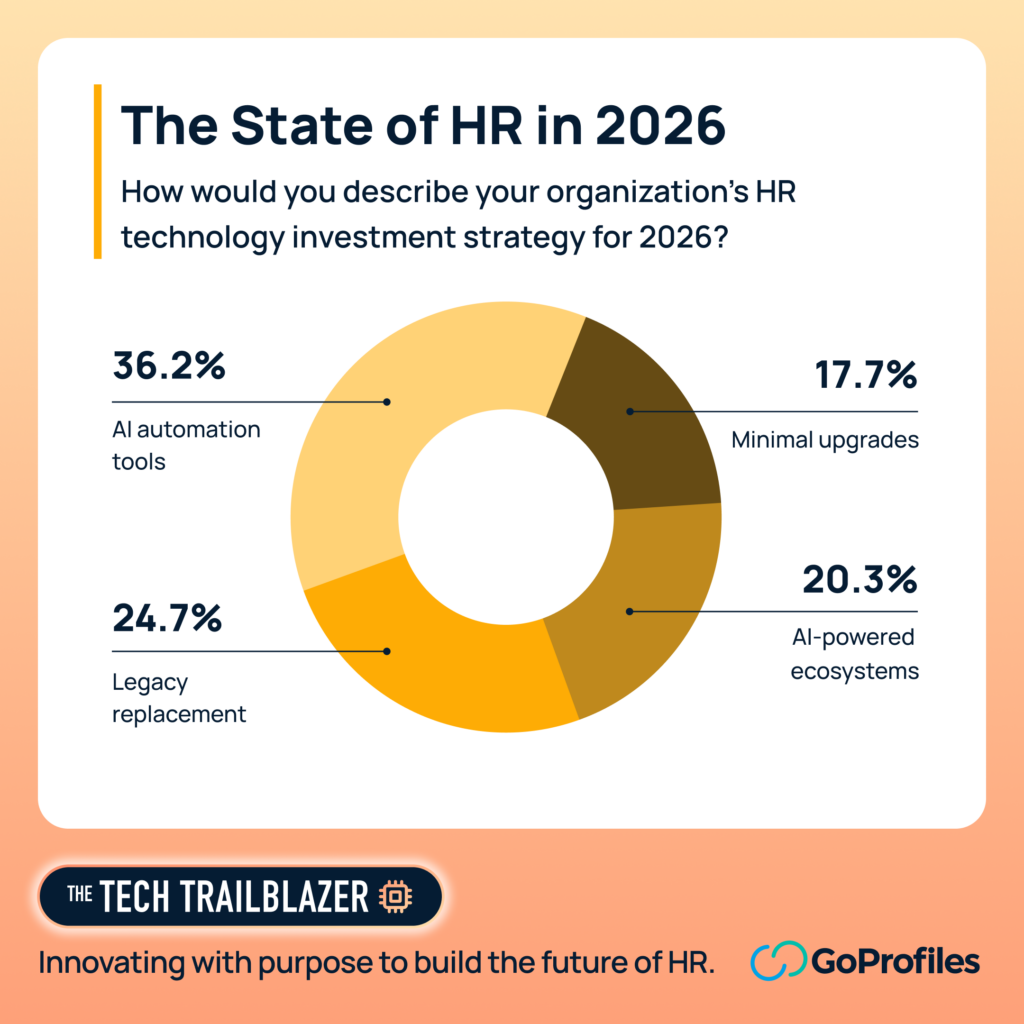
Survey data reveals four dominant HR technology investment strategies shaping 2026:
AI-Driven Automation (36.2%)
The largest group is investing in AI tools that automate workflows, augment decision-making, and improve efficiency across the employee lifecycle — from recruiting and onboarding to performance and engagement.
Legacy System Replacement (24.7%)
Nearly one quarter of organizations are actively replacing outdated HR platforms with modern, cloud-based systems that support integration, analytics, and better user experience.
AI-Powered HR Ecosystems (20.3%)
One in five organizations is pursuing a platform-first approach — building integrated, AI-powered HR ecosystems that unify data, workflows, and intelligence end-to-end.
Minimal Upgrades (17.7%)
A shrinking minority plans to maintain existing systems with limited enhancements, prioritizing stability over transformation.
Together, these trends signal a clear tipping point. Nearly 60% of organizations are already deploying AI-enabled HR technology or building AI-powered ecosystems — while fewer than one in five remain in maintenance mode.
Why HR Technology Has Become the Top Investment Priority
AI as a Strategic Accelerator
Generative AI and machine learning are fundamentally reshaping what HR teams can deliver. Rather than simply automating tasks, AI enables HR to operate with speed, precision, and scale that were previously impossible.
AI allows HR teams to:
- Analyze workforce data in real time
- Surface insights instantly
- Recommend actions tailored to employees and managers
- Anticipate needs instead of reacting after issues arise
In resource-constrained environments, AI multiplies HR’s capacity without requiring proportional increases in headcount or budget — positioning technology as a strategic accelerator rather than a cost.
Integration Beats Fragmentation
Another major driver of HR technology investment is the growing cost of disconnected systems. Recruiting, performance, engagement, learning, and recognition often live in separate platforms, creating friction and limiting insight.
HR leaders are increasingly prioritizing integrated HR technology platforms that unify data and workflows across the full employee lifecycle. Integration reduces manual work, improves data quality, and enables analytics that connect people decisions to business outcomes.
Fragmented HR tech stacks are no longer just inefficient — they actively constrain growth.
Rising Pressure to Prove ROI
As HR technology budgets rise, scrutiny increases. HR leaders are under pressure to clearly connect technology investment to outcomes such as:
- Retention and time-to-productivity
- Workforce agility and skills readiness
- Engagement and employee experience
- Productivity and performance
Modern HR platforms enable this shift through real-time analytics and outcome-driven reporting — helping HR leaders tell a clearer ROI story and position HR as a strategic partner rather than a cost center.
From Maintenance to Transformation
The data reveals a widening maturity gap in HR technology adoption. On one side are organizations investing in AI-driven tools and integrated ecosystems. On the other are teams maintaining legacy systems with minimal change.
This divide has tangible consequences. Organizations that invest in transformation gain faster insight, better experiences, and greater adaptability. Those that move slowly risk falling behind — not only in HR capability, but in overall competitiveness.
The question for HR leaders is no longer whether to invest in AI-powered HR technology, but how quickly they can modernize without introducing new complexity.
What This Means for HR Leaders
To maximize the impact of HR technology investment, leaders should focus on three strategic shifts.
1. Anchor Technology to Business Outcomes
Successful HR leaders frame technology decisions around measurable results — not feature checklists. Retention, productivity, engagement, and innovation should guide investment priorities. This positions HR technology as a growth driver, not an operational expense.
2. Design for Change, Not Just Today’s Needs
AI capabilities are evolving rapidly. HR platforms must be flexible, extensible, and integration-friendly. Short-term fixes that limit adaptability quickly become constraints in an AI-driven environment.
3. Use Technology to Elevate Experience
Automation alone is not enough. Employees expect intuitive, personalized, consumer-grade experiences at work. Leading HR teams use AI to enhance moments that matter — onboarding, recognition, development, and everyday support.
The Future of HR Technology Investment in 2026
The future of HR technology investment is intelligent, integrated, and outcome-driven. As AI matures and workforce data becomes more connected, HR gains the ability to deliver real-time insight and personalized experiences at scale.
This evolution transforms HR from a reactive function into a proactive system — one that continuously learns, adapts, and improves. Organizations that invest boldly now are building the foundation for resilient, high-performing workforces in the years ahead.
Discover how GoProfiles modernizes HR technology and enables personalized employee experiences at scale — schedule a demo today.
Build a culture of connection and recognition with GoProfiles
Schedule a demo