Need a little productivity boost? Join our monthly newsletter and we’ll go/link you to the latest tips and trends in tech!
When generative AI hit the workplace, getting people curious was the easy part. Tools in hand, prompting experiments, a little permission to play. People had fun with it.
I thought that would be the hard part. It wasn’t.
The hard part is getting people to actually change how they work. That gap between trying AI and rethinking a workflow you’ve run the same way for five years — that’s where most people leaders are stuck right now. I haven’t fully solved it. But here’s what I’ve learned trying to close it.
Start from the problem, not the tool
The question I get most — inside my own company and from peers I trade notes with — is some version of “where do I even start?” It’s a fair question, and an overwhelming one. My answer is always the same, and it’s meant to make the whole thing feel smaller: what problem are you trying to solve?
There are more tools than any of us can evaluate, and every vendor is promising the next breakthrough. If you start from the tool, you’ll get pulled in ten directions, investing in the wrong things. Start instead from your top company priorities, trace down through your talent strategy to the specific workflows that move them, and let that point you toward what you actually need.
Sometimes what you need isn’t even AI. Sometimes it’s plain automation. Sometimes it’s just showing someone a better prompt. When a real task comes up, I’ll tell my team to start with an AI assistant, and show them how I’d prompt it. That kind of teaching, in the flow of the actual work, tends to land far better than a separate training session ever has.
The adoption curve isn’t a line. It’s peaks and valleys.
I’ve led a lot of change. It usually moves along a curve I recognize. AI hasn’t, and that surprised me.
What I’ve watched instead is peaks and valleys. People get real momentum on the basics — prompting, drafting, working alongside a co-pilot — and they’re genuinely energized. Then comes the harder ask — rethinking how the work gets done — and that’s where things stall and the resistance creeps back in. The early wins make it look like adoption has taken hold. The redesign is where it gets hard.
And it’s harder than it looks. Rebuilding the way you’ve worked for years means taking something apart and putting it back together differently — a lot to ask of anyone, even those who embraced it early. Now I name this pattern openly with my team, because if you don’t expect the valley, you start to think the problem is your people. It’s not them. The valley is just part of how this kind of change works.
Clarity is kindness
Here’s where a lot of us hesitate, myself included. We worry that being direct about AI expectations will scare people, so we soften the message.
I’ve come to see that’s the less kind choice. Clarity is kindness. At Vidyard, we build an AI-forward product, and it would feel strange — even a little dishonest — not to work in an AI-forward way ourselves. I’d rather be straight with people about where AI is heading — here and in the wider world of work — than shield them from something they’re going to run into. If someone hears that clearly and decides it isn’t for them, I respect that completely. It’s a real choice, and an okay one.
One thing I’ll add, because I don’t think we say it enough: in a lot of organizations, we expect more AI fluency from individual contributors than from their managers. If we’re asking our people to stretch, those of us leading have to be visibly stretching too. We can’t sit this one out and ask everyone else to run.
Don’t make AI a checkbox
I learned this one by getting it wrong. The first time I included AI assessment in a review cycle, I effectively turned it into a compliance checkbox — are you using it, how much, where? People didn’t love it, and honestly, I now understand why. When AI is singled out on a performance review, it carries disproportionate weight for something that’s still early in adoption.
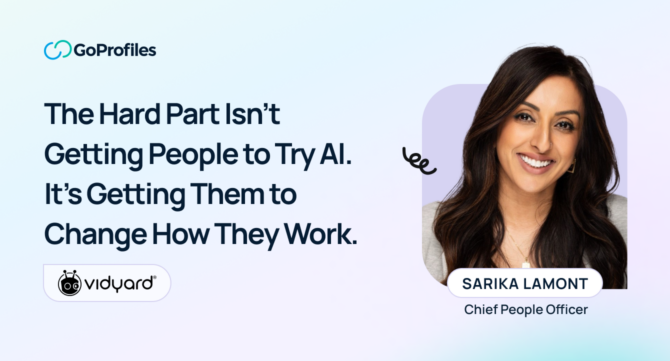
“When you make it a standalone question, it feels like a compliance checkbox. The better question is: where did you change how you approached your work — and where do you still have room to grow?”
—Sarika Lamont, Chief People Officer, Vidyard
So I rethought the approach. Now AI tools are woven into a broader reflection on how people worked and what they learned — not just checking an AI box. The question I ask: where did AI change how you approached your work, and where do you still have room to grow?
That reframe matters. AI was never the goal. The impact is the goal, and impact shows up in specifics, not abstractions. “Everyone will be 20% more productive” has never meant much to me. This does: a coding task that used to take ten hours a week came down to six, then to three, as adoption grew. That’s what real progress looks like — one task, measurably faster, and a real person with their afternoons back.
Enablement is infrastructure, not an afterthought
You can’t expect AI fluency without giving people a real path to develop it. Without that foundation, all you’re building is anxiety — and that’s a leadership gap, not a people problem. At Vidyard, our AI working council is deliberately cross-functional: engineering, IT, employee experience, and customer success all have a seat. Shared ownership isn’t optional. It’s how this actually works.
The other half of infrastructure is tooling discipline. We already lived through SaaS sprawl. AI is doing the same thing, faster. Everyone’s grabbing a different tool for every use case and wondering why nothing connects. Integration isn’t an afterthought — it’s part of the strategy, or you’re just creating a new version of the same mess.
You don’t need all the answers. You need to be honest that you don’t.
Underneath all of this is trust, and trust has never come from having every answer. It comes from being candid about the fact that you don’t.
We moved faster with AI than some of our people were ready for. Not everyone came with us — some chose to move on — but many who stuck with it have since said they’re glad they did. What made that possible wasn’t certainty on my part — it was safety on theirs. We have an internal AI channel where we share wins, swap prompts, drop interesting headlines, and own our mistakes out loud. We learn together, laugh a lot, and some days commiserate over what completely flopped. That’s not a side effect. That’s the point.
The more honest and human we let ourselves be as leaders — willing to say “I don’t have all the answers, but here’s what we’re doing, and here’s what we’re not” — the more trust we build. Trust runs on follow-through. Listen to your people, tell them honestly what you can and can’t prioritize and why, and close the loop. That’s the part people remember, and it’s what earns you the room to keep moving forward together.
The work is worth it
Closing the gap between trying AI and actually changing how you work is, ultimately, a leadership challenge. It happens through clarity, enablement, thoughtful tooling, and honesty — never through pressure.
Here’s what I actually notice: a comms draft that used to take an hour takes ten minutes. Meeting notes don’t follow me into my evenings anymore. And the time that comes back — I’m spending it with people. More 1:1s, better conversations, actually present instead of always catching up. That’s the part nobody puts in the ROI deck. AI gave me margin. I’m using it on the thing that matters most.
Sarika Lamont is Chief People Officer at Vidyard, where she leads human-centered AI transformation — helping teams rethink how work gets done through practical, secure adoption of AI and automation.