Need a little productivity boost? Join our monthly newsletter and we’ll go/link you to the latest tips and trends in tech!
The reasons employees aren’t using AI have very little to do with technology. Most organizations have already bought the tools — the gap isn’t access, it’s adoption. The real blockers are human: fear, identity, accountability, and leadership that hasn’t yet modeled the behaviors it’s asking others to adopt. Most organizations are also tracking the wrong things and training everyone the same way for a tool that demands something far more individual. The 80/20 gap isn’t a technology problem. It’s a people problem — and it requires a very different playbook.
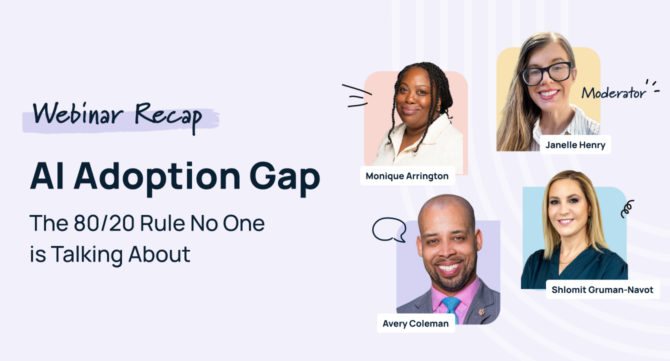
In Episode 21 of the GoProfiles HR GameChangers series, moderator Janelle Henry was joined by people leaders with deep experience in AI transformation and workforce change to dig into what’s really blocking adoption, what separates power users from everyone else, and why the conditions an organization creates matter far more than the tools it buys.
Speakers
Janelle Henry: Talent and Brand at Stripe, Advisor & Former VP of People at Rad AI & GoProfiles customer (moderator)
AI adoption is an HR problem, not an IT problem — the blockers are human and organizational: fear, identity, unclear governance, and work that hasn’t been redesigned. HR is uniquely positioned to lead, but only if it’s in the room from the start.
Literacy isn’t fluency — knowing the terminology isn’t the same as knowing how to work with AI. Measure how people actually embed it into their daily workflows, not just whether they’ve checked the training box.
Power users are defined by mindset, not role — curiosity, bravery, and a growth mindset matter more than technical background. The 80/20 gap closes when organizations build those traits across the middle, not just celebrate early adopters.
Conditions beat expectations — adoption targets without psychological safety, manager modeling, and a culture of experimentation won’t produce lasting change. Expectations only work when the environment supports them.
Measure outcomes, not activity — logins, tokens, and hours tell you almost nothing. Tie AI metrics to business results, and recognize that knowing when not to use AI is becoming a skill in its own right.
Why AI Adoption Is an HR Problem
When organizations struggle to move beyond the initial enthusiasm of an AI rollout, the instinct is often to treat it as a technology or training problem. The panel pushed back on that framing. The adoption gap, they argued, lives in the messy human work of changing behaviors, redefining roles, and confronting the unease that comes when years of hard-won expertise suddenly feel uncertain. That’s HR’s territory, not IT’s.
“The pace of change is like nothing we’ve seen before. You have to unlearn — your behaviors, your role as a leader, your sense of self. I call it the messy middle, and it might last the next two to five years. All of those are human and organizational questions.”
For Monique, the problem is compounded by where HR sits in the process. Too often, she noted, IT launches a major AI initiative and people teams are brought in only afterward — left to retrofit governance, training, and change management onto a rollout that was designed without them. The fix is structural: HR and IT in the same room from the first design conversation, not brought in after the decisions are already made.
The stakes of getting this wrong are concrete. Shlomit pointed to shadow AI — employees quietly using unauthorized tools because the organization hasn’t provided adequate access or guidance — as one of the most immediate risks. When AI isn’t treated as a people and organizational topic, the value people create on the side never gets captured, and teams drift into silos. The most advanced tools in the world, she argued, can’t fix that.
Literacy vs. Fluency: A Critical Distinction
One of the most useful distinctions of the episode was between AI literacy — knowing the language — and AI fluency — knowing how to work with AI in practice. A literate employee can define tokens and LLMs and speak the vocabulary. A fluent one embeds AI into their actual workflows and can reason about ROI, including the costs most organizations forget: tokens, tools, and the gap between top-line impact and true return. Fluency, not literacy, is what HR needs to develop and measure.
The conversation extended the point to readiness — the step most companies skip in their rush to deploy. Before asking whether AI will improve the work, the panel argued, leaders should be asking whether the organization is actually prepared to absorb it: Is the training in place? How will fluency be measured? Or is this just another trend being chased? Shlomit framed fluency itself as a portfolio rather than a single standard, with different levels appropriate to different roles — from those still resisting to those redesigning entire workflows with agentic AI. The job of HR is to know where each person sits and what they need to move up.
The 80/20 Adoption Gap: What’s Really Driving It
Nearly every organization hits the same wall after launch: a small slice of employees turn into power users while the majority stalls. The panel challenged the assumption that this is mainly a training or awareness gap. For Monique, what separates the power users from everyone else is emotional, not technical — and rolling out the same training to all of them only widens the gap.
“The real differentiator between a power user and someone opting out is fear, self-identity, and a level of shame around feeling like you can’t be good at your job if you’re using AI. AI is a very unique type of tool. We need to identify gaps in individuals, not apply a one-size-fits-all approach.”
—Monique Arrington, Senior Executive, Human Resources, Gusto
Shlomit had observed the same pattern from the other direction. The people racing ahead weren’t the engineers or the managers — they were simply the curious ones, the people with a sense of agency and a willingness to experiment. She’s watched employees who have never written a line of code build remarkable things with AI, simply because they were open to trying, comfortable saying “I don’t know,” and unafraid to fail in the process. The real challenge for HR, she stressed, isn’t celebrating those early movers — it’s giving the hesitant middle of the organization the permission and the push to follow.
Janelle distilled it to a single trait she keeps seeing in the people who adopt fastest.
“It’s yes people — people who find the paths to yes, who say, ‘I know there’s a way.’”
—Janelle Henry, Talent and Brand at Stripe, Advisor & Former VP of People at Rad AI
That led to the question every leader eventually confronts: do you incentivize adoption or mandate it? On this, Shlomit was unequivocal — pressure might produce a short-term bump, but it never builds lasting change. Expectations only take root when the conditions beneath them are real — managers actively coaching, psychological safety to experiment, leaders willing to talk openly about their own AI attempts that didn’t work. Set the targets, she argued, but build the environment first.
Measure the Outcome, Not the Activity
If organizations track the wrong things, they’ll draw the wrong conclusions — and many are. The panel agreed that activity metrics like logins, hours, and token usage are a poor proxy for real impact. Monique traced the problem back to a planning gap: companies hand out a fixed token allotment and expect a predictable level of output, without ever testing what a given team actually needs.
“You have to experiment within teams, establish baselines, and stay willing to adjust. And frankly, not everything needs AI.”
—Monique Arrington, Senior Executive, Human Resources, Gusto
Shlomit’s answer was simpler: measure outcomes, not usage.
“Understand the ‘what for,’ then measure the ‘what for.’ The question isn’t whether our teams are using AI — it’s whether we used it to improve a specific outcome, and whether we can see it working.”
She pointed to organizations that have rebuilt entire functions around agentic AI — humans and agents working in tandem, with clear governance over the data involved — and seen measurable, sustained gains in the outcomes that matter to the business. The headline was never that teams were using AI; it was that a specific result had improved, and they could prove it. She also named a skill organizations rarely think to build: knowing when not to build an agent at all. Not every use case needs one, and recognizing that restraint, she predicted, is about to become its own competency.
Getting Started: The Advice That Actually Helps
The panel had practical advice for the question every HR leader eventually faces: how do you help someone who doesn’t know where to begin? Shlomit kept it simple — start with your biggest pain and build a workflow around it. Monique offered a framing she picked up early in her own adoption journey: make a list of the problems you face every day that you shouldn’t be spending your time on, then a second list of the ones you think your leaders struggle with. Work through them steadily, building an agent or skill to solve one at a time. The exercise does more than save time — it surfaces the real problems hiding inside the organization.
Janelle picked up the thread with a point about where fluency is allowed to begin. Adoption doesn’t have to start at work, she noted — and pushing people to experiment on low-stakes personal problems is often what makes it stick. But she also flagged the quieter risk on the other side: over-reliance. Look at the calculator app on your phone, she joked, and check the embarrassing equations you’ve punched in instead of doing the math yourself.
“We need to make sure we’re not getting lazy and overusing AI on the things we should know ourselves.”
—Janelle Henry, Talent and Brand at Stripe, Advisor & Former VP of People at Rad AI
Hidden Blockers: Beyond the Training Gap
When employees resist AI even after training and access are in place, the blockers run deeper than they appear. Monique spends much of her change-management work confronting the fear directly — asking resistant clients to “run the tape” on their worst-case scenario and walk through what AI actually replacing them would look like, whether that’s realistic right now, and what the data actually suggests. Played out honestly, the catastrophe usually deflates, and curiosity takes its place.
Shlomit named a blocker that rarely gets discussed: accountability. As workflows are redesigned around agents and humans working side by side, employees are genuinely unsure who owns the result — and that ambiguity feeds the broader problem of “work slop,” output that looks polished but lacks real substance. Her rule is blunt: if you can’t put your name on it, don’t send it. Building that accountability into AI workflows, she argued, is now part of the work itself.
Monique took the idea a step further with a reframe she uses when teaching an AI literacy course to high schoolers — one that applies just as well to resistant employees.
“I tell them: whatever job you take, you’re going to be a manager — of workflows, of a bot, of code. The people who don’t adopt AI are often individual contributors who struggle to manage programs. That’s the gap we have to close.”
—Monique Arrington, Senior Executive, Human Resources, Gusto
Why Managers Make or Break Adoption
The panel’s closing question cut to the heart of the conversation: can an organization adopt AI effectively if its managers aren’t using it themselves? Monique’s answer was unequivocal — no. Without managers modeling the behavior, the enthusiastic few move ahead and everyone else stays put. And the damage is practical as well as cultural: when an employee hits a wall — a skill that won’t work, an agent that won’t connect — and their manager has no idea how to help, the employee quietly concludes the whole thing must not matter. Role-modeling, she argued, has to come before any expectation of adoption.
Shlomit pointed to research from BetterUp that highlights why not all manager buy-in is equal. The study sorts managers into four archetypes based on how they pair AI with investment in their people, and the standout group, the Calibrators, builds the conditions where AI actually improves performance. The unsettling counterpart: in low-coaching cultures, heavier AI use can actively degrade performance. What struck Shlomit most was that the strongest and weakest managers can look identical on an adoption chart — same usage, very different results.
“One only cares about AI output and not the human side. The other cares about both — the coaching, removing the fear, all the human things that were always there. Those are the best managers in current times.”
The same logic extends upward. Shlomit has watched CEOs accelerate adoption simply by normalizing it — talking openly about their own AI use, hosting open sessions where anyone can share what they’ve built, personal projects included. Only once a behavior is normalized, she noted, can an organization credibly expect it.
The Adoption Gap Is a People Gap
AI adoption doesn’t stall because of bad tools. It stalls because of unaddressed fear, missing accountability structures, managers who can’t model what they haven’t built, and measurement systems that confuse activity with impact. The organizations closing the adoption gap are the ones treating this as what it actually is: a people challenge — one that HR is uniquely equipped to lead.
For More HR Technology Insights, Check Out Our Previous Episodes:
Join us as we explore how HR leaders are breaking down silos to build integrated people experience playbooks—and what it takes to deliver a consistent, connected experience at every stage of the employee journey.
Emily Deuser is Content Manager at GoLinks, GoSearch, and GoProfiles, where she helps enterprise teams cut through the noise around workplace AI and find tools that actually make knowledge accessible. She specializes in turning complex productivity challenges into clear, actionable guidance that helps teams work smarter every day.
AI doesn't create a trust gap. It exposes the one already there. Five HR and future-of-work leaders on what actually rebuilds employee trust during an AI rollout.