Need a little productivity boost? Join our monthly newsletter and we’ll go/link you to the latest tips and trends in tech!
Almost every organization can describe its employee experience. Far fewer can show you the playbook behind it. The holiday gift, the branded backpack, the annual engagement survey — these gestures all matter, but on their own they don’t compound. What compounds is a documented system: communication expectations defined at every level, channels that give people a choice in how they receive information, and measurable outcomes attached to all of it so the work survives the next budget cycle. The organizations getting this right start somewhere else entirely — with the individual employee, and with the manager who delivers most of that experience on the company’s behalf.
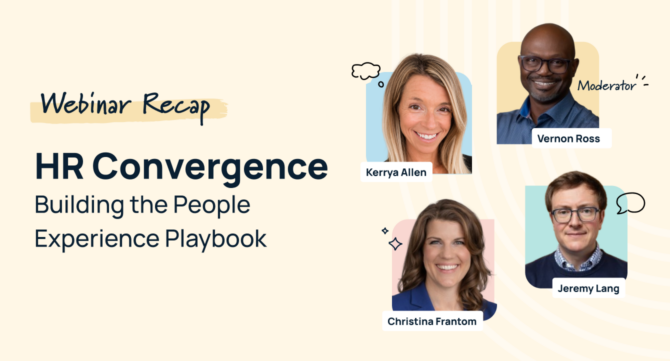
In Episode 22 of the GoProfiles HR GameChangers series, moderator Vernon Ross was joined by internal communications and employer brand leaders working across global manufacturing, media, and the consulting side of the practice to dig into what actually belongs in that playbook — how to connect people work to business results, what happens when change communications don’t land, and how to personalize at scale without losing employee trust.
Speakers
Vernon Ross: Executive Comms & AI Strategist (moderator)
Jeremy Lang: Internal & Executive Communications Leader
Key Takeaways:
Employee experience is built, not announced — aspirational definitions written in the C-suite stall before they reach anyone. Start with what specific employee groups need, then equip the manager who delivers most of that experience on the company’s behalf.
Change comms outlive the change — when the message doesn’t land, the confusion lasts for years. Leadership, culture, and operations have to move together, or the change is official on paper long before it’s real for employees.
Your best work is the problem that never happened — prevention doesn’t show up on a dashboard, which makes it a budget risk. Build the benchmark early, because programs without measurable outcomes are the first to get cut.
Choice is the playbook — what an employee needs from you changes as their life does, from a new baby to a career move inside the same company. Document communication expectations at every level, and let people receive information the way that actually works for them.
Experience is what makes speed safe — AI accelerates whatever you point it at, including the mistakes. Staged rollouts, tiered training, and a clear narrative about what isn’t being replaced keep adoption ahead of the fear.
Managers aren’t a distribution channel — they’re where a company-wide message becomes personal. Treating them as a relay station wastes the only group positioned to do that translation.
Why People Experience Starts at the Bottom
When organizations set out to define their employee experience, the instinct is to start at the top. Leadership sets a vision and announces what people experience means across the business. The panel pushed back on that sequence. Jeremy has watched it stall in tech, manufacturing, and operations alike.
“Organizations tend to start at the top with something big and aspirational. Success comes when you flip that.”
Flipping it means understanding what individual employee groups actually need, then tracing where the interactions are really happening. Those interactions, he noted, are rarely with the C-suite — far more often they run through a direct manager. The reframe changes the question entirely. Instead of debating what the experience should stand for, leaders start asking whether they are equipping the person who shapes most of an employee’s day, and the strategy takes shape from the ground up.
For Christina, the challenge is compounded by range. At Mercedes-Benz, warehouse workers, desk workers, and field teams don’t share a single experience, and a workforce spread across locations and shift patterns can’t be served by one message. Mapping that range, she noted, is the real work, and no top-down statement gets you there.
Why Change Comms Outlive the Change
Kerrya offered the clearest illustration of how much rests on change communications: the change itself is a single moment; the communication around it runs for years. SiriusXM is a portfolio built through acquisition, and the company name doubles as its flagship product — so internally, the culture can still feel different from one brand to the next.
For Kerrya, this was never one department’s problem to solve. Leadership sets the foundation, the people team makes a merger feel like the opportunity it can be, and operations aligns the mechanics.
“Often, employees see mergers and acquisitions as a negative. But it could be an exciting environment where there’s new opportunity.”
Miss any of the three, she argued, and the change becomes official on paper long before it is real for the people living through it.
Put a Number on the Problem That Never Happened
Comms and HR share a measurement problem the rest of the business doesn’t: their best work shows up as problems that never happened. Christina named it directly. Both functions prevent far more than they produce, and prevention doesn’t show up in a dashboard. An ounce of prevention is worth a pound of cure, as she put it — but the pound of cure is the only one with a line item. The stakes, she stressed, are practical.
“When you don’t have a number, and you’re not directly connected to the bottom line, your incentives get deprioritized.”
Jeremy shared a real-world example from a global tech company where he built the internal comms function from scratch. Reach metrics, he found, prove nothing — publishing to an intranet homepage says nothing about who absorbed the message or acted on it. What worked instead was a quarterly communications survey, essentially NPS for comms, built around one question: whether employees better understood the strategy and their own role in it because of communications. That single line gave him a number to take to leadership and a baseline to measure against, so progress could be tracked rather than claimed.
Make the Survey an Experience, Not an Email
Employee listening usually gets treated as a survey to send. Kerrya’s team treated it as a product to launch. The friction going in was familiar — comms asking HR for a few more questions, HR pointing at the long list already there — but rather than fight for real estate inside the survey, they rebuilt the experience around it.
“It shouldn’t be a one-way message. It shouldn’t just come from the comms team. It needs to come from the leaders.”
In practice, that meant a calendar hold spanning the two-week response window, so the reminder surfaced every time someone opened their calendar for another meeting, with Slack nudges running alongside it. But the piece that moved the number was leaders asking their own teams to participate, having already taken it themselves. The result was the strongest participation rate the company had seen.
But the experience only matters if the listening behind it is real. Asked which moments carry the most long-term weight with employees, Christina gave an answer that runs counter to every incentive catalog on the market.
“It has nothing to do with what you give. It’s whether you’re listening. Are you actually taking the time to go back to the basics and ask your employees what they want?”
Her point was that any program built on assumptions about what employees want tends to miss the mark, while asking first — through surveys and focus groups — puts the same budget to work. Kerrya extended the thought to the step organizations most often skip: what happens once the responses are in. Employees are told their feedback will shape the company’s direction, she noted, and then hear nothing back. Transparency about the work happening behind the scenes, even before the answers are finalized, is what people remember.
What Actually Belongs in the Playbook
Vernon framed the scope of the problem. A people experience playbook has to hold the full arc of someone’s time with a company — from the first recruiter conversation through to life as an alumnus.
“It’s part of the journey — from people coming into your companies as a candidate all the way through to a retiree and alumnus. All of those little moments that happen.”
—Vernon Ross, Executive Comms & AI Strategist, Speaker, Author
Asked what belongs in that playbook, each panelist pointed to a different piece: how it looks, how it’s structured, and how it adapts.
For Kerrya, it starts with visual communications, and the principle that internal audiences deserve the same care a company puts into its customer-facing work. Employees should feel like part of the brand. People are served content on their phones, watches, computers, TVs, and in their cars all day, and internal messages compete in that environment.
“To make things simple and memorable — snackable — a visual asset is something that needs to go into a playbook.”
Jeremy focused on defining communication expectations at every level. Writing it down does two things at once. It connects everyone to the same system, and it stress-tests for misalignment that nobody knew existed. It also reveals where the real gap sits: managers written off as weak communicators usually don’t lack the skill, they lack a clear brief. They imagine it has to be a big production when the fix is a few concrete things to do in a weekly meeting.
Christina’s answer is choice at every touchpoint, grounded in a fact she argues most experience design ignores.
“No one employee has a static experience — not even across their own time as an employee in your organization.”
People marry, divorce, have children, and change careers within the same company. A program designed for one version of a person expires quickly. Her team runs brief, frequent video messages instead of long executive addresses, anchors everything to a single parent document on the intranet, and lets people take it in however they prefer — including the team members who still print things out.
AI Is a Speed Tool: Experience Makes It Safe
Christina’s organization has been here before. Robotics arrived on the assembly floor decades ago, and reskilling has run continuously ever since. Her favorite illustration is the knocker-upper — the pre-alarm-clock trade of waking factory and mining shifts by rapping on windows and doors, a thriving little profession wiped out by a single cheap device. The pattern repeats, she noted, but it creates as fast as it removes: her team now employs agent developers doing work that didn’t exist two years ago. Speed is the part that needs to be governed.
“AI is a speed tool. And experience is what makes speed safe. If you hand somebody a race car who just got their license, they’re not even going to be able to make it one lap.”
Kerrya’s team is pacing it deliberately as well, with staged rollouts of each new tool. They sit inside People and Culture, which makes them early testers — and the ones responsible for the narrative. That narrative has real work to do: this doesn’t replace managers, it doesn’t remove human touchpoints, and it isn’t unsupervised. The questions employees will ask, she noted, are the ones communicators always answer. Why are we doing this? What does it mean for me? What do I need to do?
Christina’s organization approached the fluency problem through a belt-based training program. Everyone levels up together, regardless of role, which helps the organization speak one language and puts IT, already fluent, on common ground with everyone else.
Why Managers Make or Break Personalization
The panel’s closing thread was personalization — something everyone wants, and few deliver fairly across executives, frontline workers, managers, and admins alike. Jeremy’s honest take was that nobody has it solved, and anyone with a tidy answer probably hasn’t thought it through. But he named one change worth making now.
“Stop treating managers as part of a cascade, or as part of leader comms. Start thinking of them as a unique group that’s vital to your ability to personalize.”
Pushing a single C-suite message down to the frontline, he argued, is no longer a viable strategy. Even where it’s technically possible, it isn’t how people take in information anymore. Managers are where a company-wide message becomes personal, and reducing them to messengers wastes the one group that can actually do it.
Christina’s plants offer a preview of personalization at full infrastructure, and the discipline shows most clearly in timing. They run multiple shifts, so comms operate around the clock, segmented by topic through an employee app. Push notification timing is deliberate because sending too early wakes the night shift, and sending too late misses the day shift on their way home. The goal, she noted, is never to touch people unless the touch is intentional and the data supports it.
From the We to the Me
Every organization on this panel is solving the same equation under different constraints — a legacy brand running plants with three generations on the floor, a growing media portfolio built from many brands, a consulting practice watching the pattern repeat across industries. What connects them is a refusal to treat employee experience as a set of one-off perks. Jeremy closed the session with the test that holds the whole playbook together.
“Be relentlessly employee-focused. Take everything from the ‘we’ to the ‘me.”
The challenge is real. A frictionless customer experience looks effortless precisely because so much work goes into making it look that way. Internally, the equivalent is being the voice in the room that runs the gut check before anything ships: is this something the company wants to say, or something that solves a problem for the person on the other end? Does it make their work easier, or help them see how their day connects to the bigger picture?
Asked consistently, that question does two things at once: it proves the value of the work, and it makes the experience better. The organizations that get this right treat the employee experience as a system to design, document, and measure — not a series of disconnected programs.
For More HR Technology Insights, Check Out Our Previous Episodes:
Join us as we explore how HR leaders are rebuilding employee trust as AI reshapes the way work gets done—and what it takes to hold culture together when automation and cost-cutting collide.
Emily Deuser is Content Manager at GoLinks, GoSearch, and GoProfiles, where she helps enterprise teams cut through the noise around workplace AI and find tools that actually make knowledge accessible. She specializes in turning complex productivity challenges into clear, actionable guidance that helps teams work smarter every day.
AI doesn't create a trust gap. It exposes the one already there. Five HR and future-of-work leaders on what actually rebuilds employee trust during an AI rollout.