Need a little productivity boost? Join our monthly newsletter and we’ll go/link you to the latest tips and trends in tech!
AI is no longer a future-facing advantage — it’s the capability reshaping how organizations operate today. As teams navigate unprecedented technological change, HR leaders are redefining what it means to build literacy, trust, and readiness in an era where AI touches every workflow, role, and decision. The question isn’t whether AI belongs in the workplace — it’s how to adopt it responsibly, confidently, and at scale.
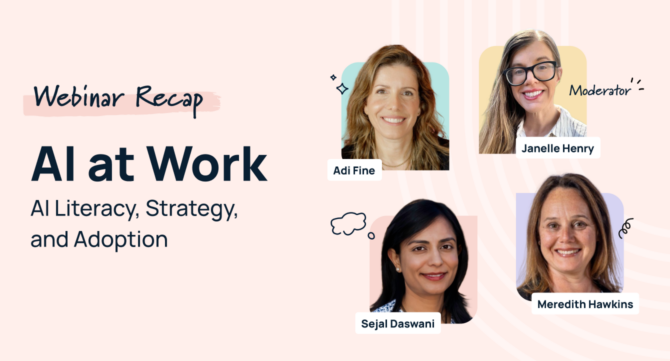
In a recent GoProfiles HR GameChangers panel, people leaders from Elementor, GoTo, and Deputy shared how they’re building AI fluency across their organizations, strengthening leader readiness, and driving thoughtful, human-centered adoption. Moderated by Janelle Henry, Talent and Brand at Stripe, the conversation explored the mindsets, systems, and practical strategies HR teams need to ensure AI becomes an enabler — not a disruptor — of employee experience, performance, and organizational growth.
For more HR technology insights, check out our previous episodes:
And if you’re not registered for the series, you can register here. And follow us on LinkedIn to never miss a moment!
Speakers
Janelle Henry: Talent and Brand at Stripe, Advisor & Former VP of People at Rad AI & GoProfiles customer (moderator)
Adi Fine: Chief Human Resources Officer, Elementor
Meredith Hawkins: Chief People Officer, GoTo
Sejal Daswani: Chief People Officer, Deputy
Key Takeaways:
Comfort fuels adoption: AI literacy starts with hands-on experimentation — not perfection.
Leaders must go first: When executives model AI usage, it accelerates organizational buy-in.
Show, don’t tell: Real demos and use cases unlock confidence faster than training alone.
Change management needs reinforcement: AI isn’t a “one and done” rollout — it requires continuous support.
Measure outcomes, not tools: Use a clear framework (like Elementor’s 4+1 model) to track impact.
AI proficiency is becoming a core skill: Organizations are integrating AI readiness into performance conversations.
Enablement must be ongoing: Surveys, training paths, AI gyms, and internal showcases help build and sustain momentum.
Start With Literacy: Make AI Less Scary, More Accessible
AI adoption in HR begins not with strategy, but with comfort and curiosity.
“AI literacy begins with comfort, not expertise.”
—Janelle Henry, Talent and Brand at Stripe, Advisor & Former VP of People at Rad AI
Adi shared Elementor’s bold approach: a six-month program giving every employee a $50 monthly AI stipend to test tools like NotebookLM, Midjourney, and ChatGPT. Employees were encouraged to switch tools monthly to broaden exposure. The initiative ended with an AI Arena, where employees demoed what they built and even competed live against the CTO.
The result? A culture of experimentation, empowerment, and excitement — exactly what AI literacy requires.
“Any activity I do twice, I immediately ask how AI can automate it.”
—Adi Fine, Chief Human Resources Officer, Elementor
Meredith emphasized that AI learning styles differ across functions. Engineers may dive in quickly, while HR or finance teams benefit more from practical demonstrations and real use cases.
Sejal added that AI isn’t only a technical evolution, but a mindset evolution — one that every employee must embrace.
“AI isn’t replacing humans — but humans who use AI will replace those who don’t.”
—Sejal Daswani, Chief People Officer, Deputy
Build Organizational Confidence Through Role Modeling
When leaders use AI publicly, adoption accelerates.
Janelle shared that on her own team, weekly snippets included one simple prompt: share one way you used AI this week — personal or professional.
Even small, playful uses helped normalize experimentation and soften resistance.
Across all panelists, the message was consistent: leaders must model the behaviors they want to see.
“Leaders must be the role models. If we don’t use the tools ourselves, we cannot expect employees to.”
—Adi Fine, Chief Human Resources Officer, Elementor
And as Janelle emphasized:
“If we want employees to adopt AI, leaders have to model curiosity and use it themselves.”
—Janelle Henry, Talent and Brand at Stripe, Advisor & Former VP of People at Rad AI
Integrate AI Thoughtfully: Choose High-Impact Use Cases
Not every HR process is an ideal candidate for AI — and that’s exactly why intentionality matters. The panelists emphasized that successful AI adoption starts by identifying high-impact areas where automation, augmentation, and insight generation can create meaningful improvements without disrupting employee trust.
Across their organizations, several categories consistently delivered strong early returns:
Employee Support & HR Operations
Meredith shared how GoTo implemented an internal AI-powered chatbot that handled 83% of open enrollment questions without escalation. The result? Faster employee support, fewer repetitive inquiries, and more time for HR teams to focus on strategic work. As she put it:
“Use cases are the best teacher—adoption skyrockets when employees see real examples.”
—Meredith Hawkins, Chief People Officer, GoTo
Talent Acquisition
AI now plays a role across the entire recruiting lifecycle — from sourcing and screening to interview preparation and candidate messaging. For high-volume or fast-scaling teams, AI dramatically reduces administrative burden while improving consistency and response time.
Learning & Development
Whether rewriting competencies, designing personalized learning journeys, or supporting coaching conversations, AI helps L&D teams move from reactive to proactive. What once took months now takes days — or even hours.
HR Operations & Workflow Automation
AI is increasingly embedded into everyday processes: onboarding sequences, policy drafting, reporting and analytics, and automated workflow triggers. These improvements eliminate manual friction and ensure processes run smoothly behind the scenes.
Manager Enablement & Employee Growth
At Deputy, “AI Gems” demonstrate how AI can serve as a manager’s co-pilot — offering guidance for feedback conversations, development planning, coaching scripts, and performance support. Instead of replacing managers, AI strengthens their confidence and capability.
AI Adoption Requires a New Kind of Change Management
AI introduces a level of disruption unlike traditional organizational change — with shifting roles, evolving tools, and entirely new expectations. Leaders are no longer automatically the experts, processes are transforming at a rapid pace, employees may fear replacement or irrelevance, and the technology itself evolves weekly, sometimes daily.
To navigate this environment effectively, HR must prioritize leader readiness, agility, long-term thinking, and courage. Sejal emphasized that continuous exposure — such as showcasing AI wins at every company all-hands — helps normalize adoption and reduce anxiety. Meredith added that internal champions play a critical role in driving bottom-up momentum, ensuring teams feel supported rather than overwhelmed as AI becomes part of everyday work.
Measuring the Impact: Move Beyond Tool Metrics
Adi introduced Elementor’s 4+1 AI Outcomes Model, a practical framework that ensures AI initiatives deliver meaningful value. Each proposed use case must map to at least one of the following outcomes:
Productivity & Speed
Cost Savings
Innovation & Revenue Acceleration
Risk Reduction
+1: Work Feels Easier — the human experience outcome
If an idea doesn’t connect to these outcomes, it doesn’t move forward. This approach prevents “AI for the sake of AI” projects and keeps teams aligned on where the technology can make the greatest impact.
Meredith also emphasized that gaining alignment across the executive team is essential for accountability and sustained momentum. Clear outcomes make it easier for leaders to prioritize resources, measure progress, and stay unified on what success looks like.
“Leadership alignment is essential. People watch what executives do more than what we say.”
—Meredith Hawkins, Chief People Officer, GoTo
Enablement: Give Employees the Tools to Grow
Employees want to learn AI — but they need direction, structure, and ongoing support to build confidence. The panelists emphasized that enablement isn’t a one-time training; it’s a continuous ecosystem that helps employees grow alongside the technology.
They recommended several foundational steps:
Start with a sentiment survey Gauge employee fears, excitement, current use cases, and confidence levels. Understanding the baseline ensures your enablement strategy meets people where they are.
Build tailored training paths Different functions and roles need different types of AI fluency. Tailoring learning experiences makes adoption more practical and relevant.
Offer continuous, hands-on support AI gyms, internal showcases, office hours, and tool walkthroughs help employees practice in a low-pressure environment. Repetition builds confidence.
Highlight best practices across functions Deputy, for example, shares AI success stories in every QBR to reinforce expectations and spotlight what “great” looks like across the organization.
As Sejal reminded the audience:
“Work is changing. AI is here. The question is: how are you evolving with it?”
—Sejal Daswani, Chief People Officer, Deputy
Do This Now: Quick Wins for HR Leaders
To accelerate AI adoption across your organization, start with small, visible actions that build credibility and momentum. The panelists emphasized that HR doesn’t need to roll out a complete roadmap on day one — you just need to start.
1. Use AI today. Pick one task — drafting a policy outline, rewriting a job description, analyzing survey data — and try using AI to improve or accelerate it. Then share what you learned.
2. Talk about it openly. Normalize curiosity by discussing where AI helped, where it didn’t, and what you’re trying next. Transparency reduces fear and encourages employees to experiment.
3. Build something that directly serves employees. Adi created a simple WhatsApp notification bot to approve urgent items faster, eliminating delays and improving response time. Small innovations like this demonstrate what’s possible — and inspire others to try.
The message is clear: Leaders don’t need perfection — they need visible momentum. Start small, share often, and model the mindset shift you want your teams to embrace.
Final Thoughts
AI isn’t just a technology shift — it’s a leadership shift. HR plays a defining role in building organizational confidence, capability, and curiosity.
Whether you’re upskilling employees, driving AI adoption, or shaping strategy, one truth stands out: The future belongs to teams who embrace AI with courage, clarity, and intention.
Build the people foundation your organization needs for the AI era. Discover how GoProfiles helps HR leaders strengthen visibility, connection, and engagement across every team. Try GoProfiles today.
Build a culture of connection and recognition with GoProfiles
Join us to explore the essential skills leaders must master in 2026 to build resilient, inclusive, and people-centered organizations while navigating digital change.