



Peer-to-peer recognition software lets any employee publicly recognize a coworker, often with points or a reward attached. Yet only 34% of employees say their employer has a recognition program in place, according to Workhuman and Gallup.
This guide compares 10 peer-to-peer recognition software tools on the questions HR leaders ask first: who each tool fits, how rewards and gamification work, where it integrates, whether it works for distributed teams, and whether pricing is published. A step-by-step rollout plan follows the comparison.
What Is Peer-to-Peer Recognition Software?
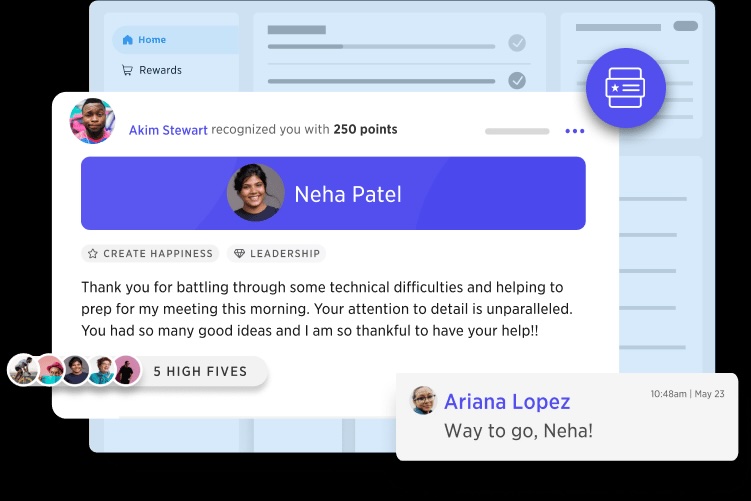
Peer-to-peer recognition software is a platform that lets employees recognize each other’s work directly, without waiting for a manager to initiate it.
In traditional recognition programs, a manager nominates, HR approves, and the award arrives weeks later. Peer-to-peer tools let anyone recognize anyone right away, in a shared feed or a Slack or Microsoft Teams channel where coworkers can see it and join in.
Peer-to-Peer Recognition Software Compared
Here’s how ten top tools compare on fit, rewards, HRIS sync, and starting price. Prices are from vendor websites as of October 2026.
| Tool | Best for | Rewards | HRIS sync | Starting price |
|---|---|---|---|---|
| GoProfiles | Teams that want recognition alongside employee profiles, a company directory, and an org chart | Points redeemable for gift cards, cash-out options, and donations | Included (50+ HRIS) | Free plan; paid from $2/user/mo |
| Bonusly | Teams that want a points-first program with check-ins and 1:1s | Catalog billed at face value | Included on paid plans | Free plan; paid from $3/user/mo |
| Matter | Small and midsize teams that work in Slack or Teams and want a weekly recognition prompt | eGift cards from 3,500+ brands at face value | Paid add-on | Free plan; paid from $1/user/mo |
| Assembly | Values-based recognition with AI insights for managers | Rewards catalog | Included | From $3/user/mo |
| Awardco | Midsize and large orgs running several formal programs, including recognition from customers or patients | Amazon Business and gift cards with no markup | Paid add-on | Small-business packages from $3,000 |
| Nectar | Frontline-heavy orgs that want recognition plus internal comms and surveys | Reward cards, Amazon, and swag | Included | Contact vendor |
| WorkTango | Mid-market and enterprise orgs pairing recognition with engagement surveys | Rewards catalog | Included | Contact vendor |
| Kudos | Large programs in healthcare, manufacturing, and financial services | Points-based rewards catalog | Via connectors or API | Contact vendor |
| Fringe | Orgs that want recognition and lifestyle benefits in one points wallet | Lifestyle benefits (100+ options) | Included (20+ HRIS) | Contact vendor |
| Workhuman | Large global enterprises with formal, budgeted recognition programs | Rewards store | Included (Workday) | Contact vendor |
How to Choose Peer-to-Peer Recognition Software
Most peer-to-peer recognition software covers the basics: a shared recognition feed, badges, and points. The right choice depends on how well a tool matches the way your team works, how you fund rewards, and how formalized your program needs to be. Start with these four questions.
Where Does Your Team Already Work?
Pick a tool that works where employees already spend their day; otherwise, participation lags. For distributed and remote teams, that usually means Slack or Microsoft Teams, plus a mobile app for employees who aren’t at a desk. Matter runs entirely inside Slack or Teams; most other tools are standalone platforms that also post to chat.
Do You Need Monetary Rewards, and Who Funds Them?
Budget for the subscription and the reward spend separately. Some tools bill rewards at face value with no markup (Bonusly, Matter, Awardco), while others bundle catalogs with swag, prepaid cards, or lifestyle benefits (Fringe, Nectar).
How Formal Is Your Program?
Match the tool to the size and structure of your program. Service awards, nomination committees, and approval workflows matter at enterprise scale; a 50-person team may only need a shared recognition feed, badges, and a simple points budget.
Do You Want Recognition Bundled With Other HR Tools?
A bundle means one contract and one login, but add-on modules may be weaker than standalone tools. Common bundles include engagement surveys (Nectar, WorkTango, Bonusly), internal comms (Nectar), lifestyle benefits (Fringe), and employee profiles with an org chart (GoProfiles).
Also look for:
- Mobile access for deskless and frontline staff
- Analytics that show who isn’t being recognized
- Leaderboards, badges, and points that reward participation
- AI writing help that turns a quick note into specific, values-aligned recognition; most platforms now offer it, so compare the quality of the suggestions rather than whether the feature exists
10 Best Peer-to-Peer Recognition Software Tools for 2026
1. GoProfiles
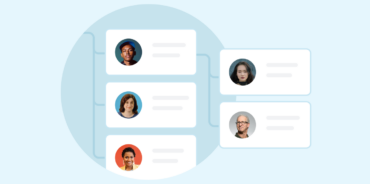
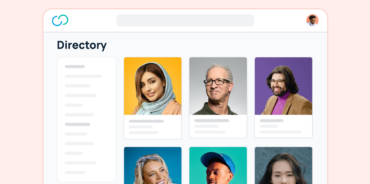
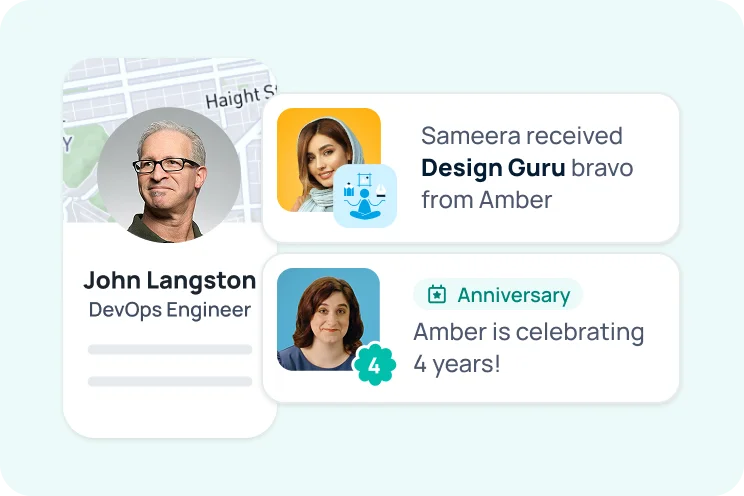
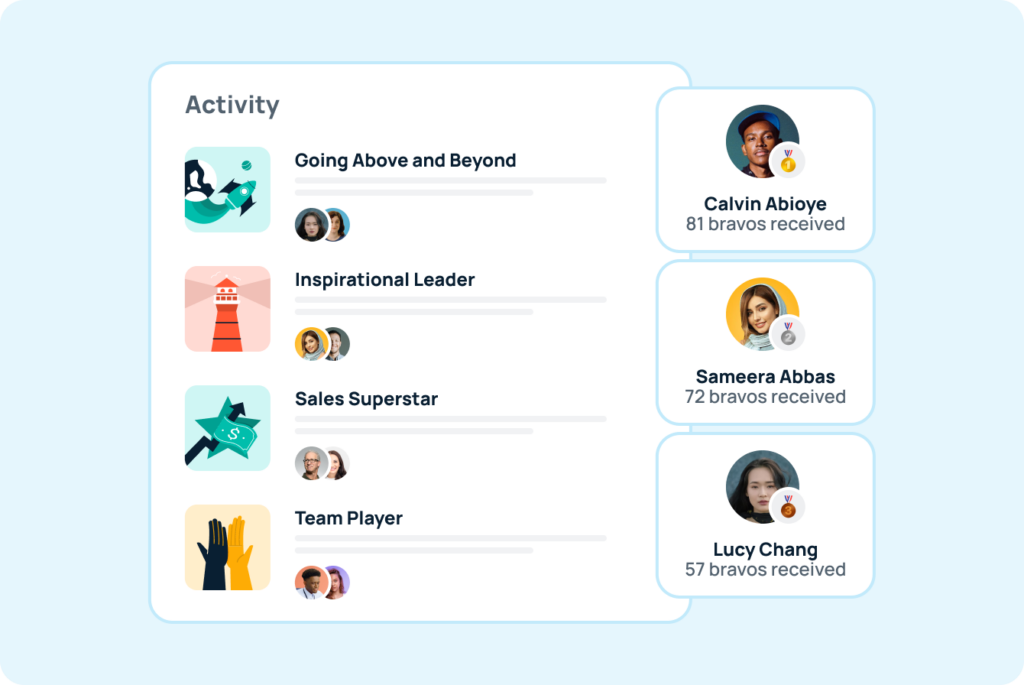
GoProfiles pairs peer recognition with employee profiles, a company directory, and an org chart, so every bravo and achievement badge shows up on the recipient’s directory profile for colleagues to see. In GoProfiles, employees send bravos with custom badges, attach reward points redeemable for gift cards or donations, and share recognition to Slack, Microsoft Teams, or Google Chat. GoAI suggests a badge as you write, and GoProfiles spotlights the top bravo recipient each month on a company-wide leaderboard.
- Best for: Remote and hybrid teams that want recognition, a searchable directory, and an org chart in one place, synced from 50+ HRIS platforms.
- Watch for: GoProfiles doesn’t include engagement surveys or formal nomination workflows. Paid plans carry 25- and 50-user minimums, and the mobile app is iOS only.
2. Bonusly
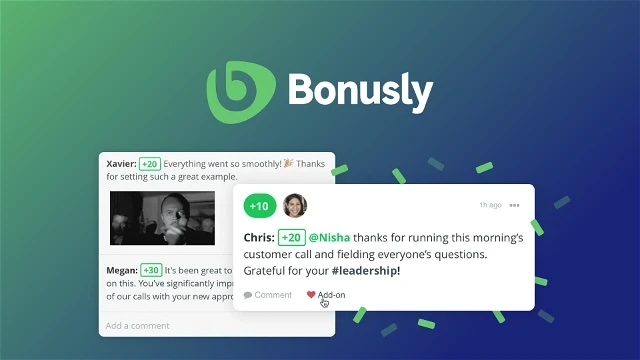
Bonusly gives each employee a monthly points budget to give coworkers with each recognition, and recipients redeem those points from a catalog billed at face value. Bonusly’s paid plans add automated milestone celebrations, check-ins, 1:1 agendas, and the Bizy AI assistant.
- Best for: Teams that want a points-first program with published per-user pricing.
- Watch for: Bonusly’s awards, incentives, and company-wide analytics sit on the custom-priced Organization plan. Bizy adds $2 per user per month to the base Team price.
3. Matter
Matter runs recognition entirely inside Slack or Microsoft Teams, with no separate login. Matter’s weekly Feedback Friday prompt nudges teams to recognize each other, and its free plan has no user limit.
- Best for: Small and midsize teams that already work in Slack or Teams and want a low-cost entry point.
- Watch for: Matter’s rewards require the Pro plan, and HRIS sync is a paid add-on. Teams that don’t use Slack or Teams have no place to run it.
4. Assembly
Assembly, now part of Quantum Workplace, ties recognition to company values. Assembly’s Dora Hub surfaces AI insights for managers, such as who on a team is going unrecognized.
- Best for: Organizations that want values-based recognition and manager-level signals in one tool.
- Watch for: Assembly’s peer-to-peer recognition starts on the Empower plan. Ask how the Quantum Workplace acquisition affects the roadmap and contract terms.
5. Awardco
Awardco organizes its plans around recognition types: spot, nominations, automated milestones, earn-based incentives, and external recognition from customers or patients. Awardco’s rewards network includes Amazon Business with no markup.
- Best for: Midsize and enterprise organizations running several formal programs, such as service awards, sales incentives, and patient-to-caregiver recognition.
- Watch for: Awardco’s pricing is quote-based. HRIS sync, the A-Pay payment card, and the company store are premium add-ons.
6. Nectar
Nectar offers peer shoutouts, nominations, challenges, and milestones, with add-ons for internal comms and surveys. Kiosk mode and SMS help Nectar reach deskless staff.
- Best for: Healthcare, manufacturing, and other frontline-heavy organizations that want recognition and communications from one vendor.
- Watch for: Nectar doesn’t publish pricing; bundles are quoted by industry and workforce type.
7. WorkTango
WorkTango, formerly Kazoo, combines recognition and rewards with engagement surveys and people analytics. WorkTango users can send recognition from Slack, Microsoft Teams, or Outlook.
- Best for: Mid-market and enterprise organizations that want recognition data next to engagement survey results.
- Watch for: All WorkTango plans are quote-based. Older reviews still refer to the product as Kazoo, which can complicate research.
8. Kudos
Kudos is a configurable recognition platform with awards, nominations, automated milestones, and internal announcements. Kudos launched a rebuilt platform in October 2025 with automated workflows, audience segmentation, and AI-assisted recognition.
- Best for: Large organizations, especially in healthcare, manufacturing, and financial services, that need configurable programs across thousands of employees.
- Watch for: Kudos doesn’t publish pricing, and its breadth can be more than a small team needs.
9. Fringe
Fringe is a lifestyle benefits platform with recognition built in. In Fringe, peer and manager recognition adds points to the same wallet employees use for meal kits, childcare, travel, and wellness.
- Best for: Organizations that want to consolidate stipends, perks, and recognition into one platform and one invoice.
- Watch for: Fringe is benefits-first. Buyers who need advanced recognition features, such as nomination committees, should compare its recognition module against recognition-first tools.
10. Workhuman
Workhuman covers peer and manager recognition, service milestones, life events, and team awards. Workhuman admins get spend controls and approval workflows, and employees can send recognition from Slack, Microsoft Teams, Outlook, or Workday.
- Best for: Large global enterprises that run budgeted recognition programs with formal approvals.
- Watch for: Workhuman doesn’t publish pricing or offer a free plan, so small teams can’t easily evaluate it.
Why Peer-to-Peer Recognition Software Matters
Recognized employees stay longer, which makes recognition a retention strategy, not just a morale boost. In a study that tracked more than 3,400 workers from 2022 to 2024, Gallup and Workhuman found that well-recognized employees were 45% less likely to have left their jobs two years later.
The quality of recognition matters as much as how often it happens. Employees who receive great recognition are 20 times as likely to be engaged as those who receive poor recognition, according to Workhuman and Gallup’s 2023 report.
Managers can’t deliver that kind of recognition on their own. Peers see the day-to-day work managers miss, like a colleague who unblocked a project, covered a shift, or answered a late question in Slack. Peer-to-peer recognition software makes those moments visible to the whole team.
How to Implement Peer-to-Peer Recognition Software
A recognition tool only helps if people use it, and that comes down to how you roll it out. These eight steps cover launch and the months that follow.
1. Define Objectives and Goals
Decide what the program should achieve before you launch it: higher engagement scores, stronger cross-team collaboration, or everyday behavior that reflects company values. Pick one or two measurable goals, because they determine what you track and how you evaluate the program’s impact.
2. Gain Leadership Buy-In
Build the case around outcomes leaders already track, such as engagement scores and retention. Ask executives to send the first round of recognition themselves. When employees see leaders using the tool, they’re more likely to join in.
3. Develop Recognition Guidelines
Define which behaviors and achievements earn recognition and tie them to company values. Set point budgets and reward rules before launch so employees know how points work from day one.
4. Communicate Program Details
Explain how the program works, what earns recognition, and why it matters, using channels employees already pay attention to, such as all-hands meetings, email, and internal newsletters.
5. Train Employees and Managers
Teach employees how to write recognition that is specific, sincere, and timely. Then help managers spot team members who are being overlooked and use participation reports to close the gaps.
6. Launch With Early Momentum
Kick off with a company-wide meeting or launch campaign, and fill the recognition feed with posts from leaders and early adopters on day one, so employees see active recognition the first time they log in.
7. Keep Participation Going After Launch
Share examples of standout recognition in company channels, celebrate program milestones, and use leaderboards or reward incentives to keep recognition going well past the first few weeks.
8. Review Results and Refine the Program
Review participation data monthly and ask employees what’s working. Adjust budgets, badges, and guidelines as the program matures.
Find the Right Peer-to-Peer Recognition Software for Your Team
With the right tool, recognition becomes part of everyday work, not something saved for annual reviews. Use these comparisons to shortlist two or three tools that fit your team’s workflow, rewards budget, and program size. Then ask each vendor to demo how recognition, rewards, and reporting would work for your organization.
Want every bravo to show up on the profile coworkers already check? GoProfiles brings peer recognition, rewards, employee profiles, and an org chart into one place. Book a demo for a walkthrough tailored to your team.
Build a culture of connection and recognition with GoProfiles
Schedule a demo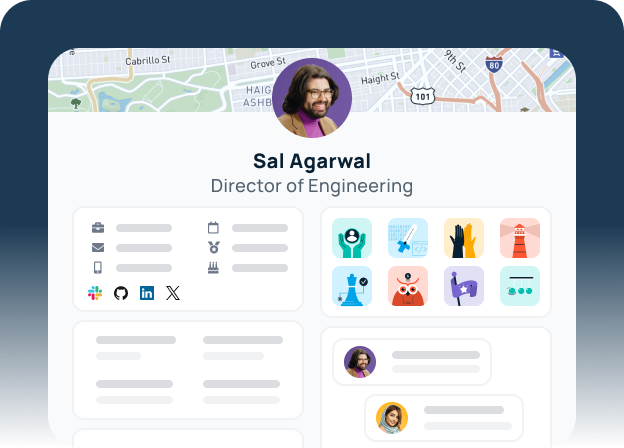
Frequently Asked Questions About Peer-to-Peer Recognition Software
How Much Does Peer-to-Peer Recognition Software Cost?
Self-serve plans range from $1 to $5 per user per month, and GoProfiles, Bonusly, and Matter offer free plans. Enterprise-focused tools such as Workhuman, Kudos, Nectar, and WorkTango quote custom pricing. Budget separately for rewards, which most vendors bill at face value only when employees redeem their points.
Does Peer-to-Peer Recognition Software Integrate With Slack, Teams, and HR Systems?
All 10 tools on this list connect to Slack, Microsoft Teams, or both, and Matter runs entirely inside them. Most also sync employee data from an HRIS, though some include it on paid plans and others sell it as an add-on. Check that your specific HRIS is supported before signing.
Which Peer-to-Peer Recognition Software Has Leaderboards and Gamification?
GoProfiles includes a recognition leaderboard, custom badges, and achievements, and it spotlights the top bravo recipient each month. Matter, Nectar, Assembly, and Kudos offer recognition challenges, and Awardco supports earn-based incentives and competitions. Points-based rewards in most of these tools add another layer of gamification. If leaderboards are a must-have, ask each vendor to walk you through them in a demo.
What’s the Best Peer-to-Peer Recognition Software for Remote Teams?
Remote teams need recognition in the chat tools they already use, a mobile app, and HRIS sync so the employee list stays current. All 10 tools connect to Slack, Microsoft Teams, or both. Bonusly has iOS and Android apps, Nectar adds kiosk mode and SMS for deskless staff, and GoProfiles has an iOS app. GoProfiles and Bonusly both include HRIS sync on paid plans.
What’s the Difference Between Peer-to-Peer Recognition and Employee Recognition Software?
Employee recognition software is the broader category and includes manager-led programs, service awards, and nominations. Peer-to-peer recognition is one capability within it: any employee can recognize any other, without approval. Most tools here support both.
How Do Peer-to-Peer Recognition Software Tools Handle Privacy and Data Security?
Look for SOC 2 Type II certification, GDPR compliance, SSO, and role-based access controls. GoProfiles, Matter, and Assembly each publish SOC 2 Type II compliance on their websites; ask other vendors for their reports during evaluation.
How Do Peer-to-Peer Recognition Tools Support a Global, Multilingual Workforce?
Many platforms offer multi-language interfaces, region-specific reward catalogs, and budgets that adjust for local purchasing power. Nectar, Awardco, and Matter, for example, advertise global reward catalogs covering dozens or hundreds of countries.