Need a little productivity boost? Join our monthly newsletter and we’ll go/link you to the latest tips and trends in tech!
The conversation about AI at work has shifted. It’s no longer about whether to adopt — it’s about how to integrate AI so deeply into daily workflows that the distinction between “using a tool” and “working with a teammate” starts to blur. That shift brings real opportunity, and real risk: teams that get it right will move faster, scale further, and free their people to do the work that actually matters. Teams that don’t will find themselves outpaced by organizations that did.
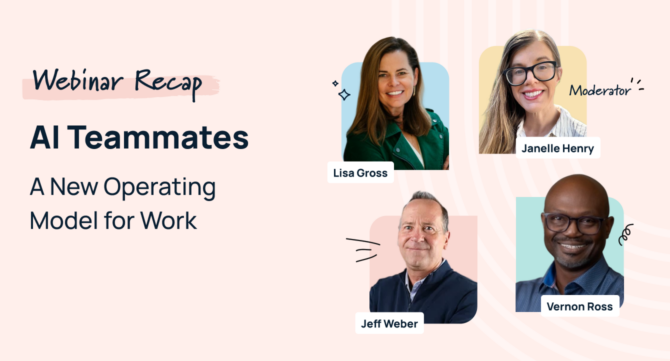
In a recent GoProfiles HR Game Changers panel, experienced people leaders and AI pioneers Lisa Gross, Jeff Weber, and Vernon Ross joined us to unpack what that shift looks like in practice. The conversation covered everything from where to draw the line between AI as tool and AI as teammate, to the governance guardrails that make fast adoption sustainable, to the workforce-level question that nobody is talking about loudly enough.
For more HR technology insights, check out our previous episodes:
Vernon Ross: Executive Comms & AI Strategist, Speaker, Author
Key Takeaways:
Process first, AI second — AI doesn’t fix broken workflows; it accelerates them.
Automation is just the beginning — the real leverage is in what your people do with the time they get back.
Adoption follows experience — specificity, hands-on access, and a culture of show-and-tell are what actually move the needle on AI buy-in.
Experimentation without measurement isn’t a strategy — the organizations seeing ROI on AI have set clear metrics and are tracking against them.
The entry-level playbook is being rewritten by AI — HR leaders who invest in workforce development now will be the ones who bring the next generation along.
Discernment Is Your Superpower
The question sounds deceptively simple: where do you draw the line between AI as a tool and AI as a true teammate? But the panel’s answers revealed that most organizations are asking the wrong version of it. The more useful question, as Vernon Ross argued, isn’t how much to trust AI — it’s developing the organizational judgment to know when that trust is warranted and when it isn’t.
“Discernment is your superpower right now with AI. You have to know when you can let AI do something for you and when you need to look over its shoulder.”
—Vernon Ross, Executive Comms & AI Strategist, Speaker, Author
For Lisa Gross, the hesitation around the “teammate” framing isn’t semantic — it’s about accountability. At Headspace, where AI is being deployed to scale mental health care to millions of people, the cost of misplaced trust isn’t abstract.
“I think of AI as a core resource on the team — one to tap into, leverage, and maximize. But I don’t think we’re yet at the place where we can wholly give over and trust it as we would a normal teammate.”
—Lisa Gross, Chief People Officer, Headspace
The organizational reality is this: AI rollout is culture change, and culture change requires clarity about what AI is — and isn’t — expected to do. Enhancing judgment, speed, and creativity is the goal. Replacing human decision-making is not.
The through-line across all three answers: the question isn’t whether AI belongs in your workflows. It’s whether your people have the discernment to know which workflows are ready for it.
You Can’t AI Your Way Out of a Broken Process
It’s a principle that cuts across every industry and org size — and one that many AI strategies violate before they get started. As Vernon framed it: you can’t AI your way out of a broken process.
The analogy he reaches for is audio production: garbage in, garbage out. No amount of processing fixes a bad source. Layering AI on top of broken, undocumented, or inconsistent workflows doesn’t produce efficiency — it produces faster chaos.
The more useful starting point is first principles. Before recommending any AI tooling, Vernon maps the process as if AI had existed when it was originally designed — what would it have looked like? What’s safe to automate? What still requires a human? That reframe is what separates organizations that genuinely reclaim time from those that simply add new tools to an already overloaded stack.
Automate the Routine. Elevate the Team.
Jeff Weber and Lisa Gross each put that principle into practice the same way: by rebuilding workflows around AI’s capabilities, rather than retrofitting it into existing ones.
At Breeze Airways, Jeff noted that the HR team is scaling to support rapid field hiring without growing corporate headcount. The only way that works is if the team stops spending capacity on questions that have straightforward answers. The solution: a custom-built AI tool that gives on-the-go employees immediate, role-specific answers to HR questions — and has since expanded to guide them through multi-step processes like leave requests, routing to a human only when the situation genuinely requires one. The result is a team that spends less time on repetitive inquiries and more time on the complex, high-judgment work that actually requires their expertise.
Lisa built something similar at Headspace — a Leader Hub that gives managers on-demand access to policies, procedures, and AI-assisted coaching on more complex topics like difficult conversations and conflict resolution. The goal: democratize access to great HR guidance across every manager, not just those with a dedicated partner.
Building the tool, it turns out, is often the easier part. It was the testing — running hundreds of different question variations to ensure consistent, correct responses regardless of how something was phrased — that took real time and investment.
That framework works well for straightforward answers — but for judgment-intensive work, Lisa’s rule is unambiguous:
“When something requires judgment and creativity, you go first. What do you think the right answers are? What would you do first, second, third? Then ask AI if you missed anything — or to amplify and build on what you have.”
—Lisa Gross, Chief People Officer, Headspace
That sequencing — human first, AI second — matters both for the quality of the output and for the long-term development of the people doing the work. If employees hand every difficult question to AI before engaging their own expertise, that expertise stops growing. The goal isn’t to replace thinking. It’s to make thinking faster and better.
The Antidote to Fear Is Specificity
As AI moves into more complex territory — coaching, decision support, employee relations — the trust question becomes less about the technology and more about the people being asked to use it. Resistance to AI adoption is rarely about capability. It’s about fear of the unknown. And that doesn’t respond to announcements or policy memos. It responds to direct experience.
“The antidote to fear is specificity. The more clarity you can provide, the more access you give people, the more hands-on they get with AI — it’s hard not to like it when you can get rid of the drudgery of repetitive tasks that you know aren’t value-added.”
—Lisa Gross, Chief People Officer, Headspace
For Lisa’s team, that meant starting with an AI hackathon open to everyone — no experience required. People self-selected into projects based on curiosity, not credentials, and built a culture of show-and-tell where discoveries get shared across the team. The person doing the teaching, it turns out, learns just as much as the person listening.
Jeff’s team runs a version of the same playbook. Their recurring all-team calls feature examples of how people are using AI to get things done — demos of features built, workarounds that worked, tools that replaced something broken. The goal is momentum: when people see peers building things, they start imagining what they could build themselves.
Move Fast — But Don’t Create Shadow AI
Speed is a competitive advantage in AI adoption. But speed without permission structures creates a different problem: employees building their own solutions, using personal accounts, and routing confidential company information through tools the organization doesn’t control.
Vernon identified the underlying dynamic: when people don’t feel like they have organizational permission to use AI — or the tools they’re given aren’t up to the job — they find their own solutions. The result is shadow AI: ungoverned, untracked, and potentially exposing company data. The fix isn’t to restrict access. It’s to give people better tools and explicit permission to use them. As Jeff put it:
“You have to make sure people are using your enterprise tools and not feeding confidential information into tools you don’t control. Training around security, setting guardrails, and then letting them go build — it’s been a really interesting experiment.”
—Jeff Weber, Chief People Officer, Breeze Airways
Both Lisa and Vernon pointed to the same principle: clarity of separation. Enterprise accounts for company work, personal accounts for personal use — a clean, enforced line with sensitive data subject to extra scrutiny. Vernon added a caution worth heeding in any environment: even tools that live inside your own infrastructure can have hidden external dependencies. The safeguard isn’t just what tools you approve — it’s understanding what those tools are doing under the hood.
Stop Piloting. Start Measuring.
There’s a pattern in AI adoption that most organizations recognize and few escape: the endless pilot. Teams experiment, find things that work, share anecdotes about time saved — and never build the measurement infrastructure to prove impact, scale confidently, or sustain investment.
Lisa’s approach at Headspace is a model for what it looks like to take metrics seriously from the start. Rather than tracking activity, the focus is on outcomes: quality assurance coverage, customer satisfaction, first-contact resolution rates, and the share of engineering work that’s AI-assisted. Across each area, the question isn’t whether AI is being used — it’s whether it’s moving the numbers that matter.
“You can’t just stay in experimentation for long. You have to measure it, show outcomes, and know what good looks like.”
—Lisa Gross, Chief People Officer, Headspace
At Breeze, the urgency isn’t philosophical — it’s structural. A lean corporate team supporting a rapidly growing organization has no choice but to use technology to scale. That constraint sharpens the stakes considerably. It’s also shaped how Jeff frames AI adoption in messaging to his own team: there are only two types of companies right now, those that are getting great at AI, and everyone else.
“If we don’t adapt and urgently accept AI as part of what we do every day, we’re going to fail.”
—Jeff Weber, Chief People Officer, Breeze Airways
Vernon reframed what AI-driven efficiency actually looks like in practice: production goes up, but effort doesn’t have to. The return on AI investment isn’t measured in hours saved — it’s measured in what those hours get redirected toward. The organizations that measure that redirection — not just the hours — are the ones building a sustainable case for AI investment.
The Entry-Level Playbook Is Being Rewritten
Most AI discussions focus on what organizations gain. This one didn’t shy away from what’s being lost — particularly at the entry level.
“The floor is gone. So you train people for higher things, pass the institutional knowledge on, and develop processes around how you bring folks in and get them up to speed quickly. A junior person now has to absorb all that knowledge and learn how to manage the AI — because it’s going to be the thing that holds the truth for the organization.”
—Vernon Ross, Executive Comms & AI Strategist, Speaker, Author
For Lisa, the workforce implications aren’t theoretical. As an HR leader at the intersection of mental health and AI, the erosion of traditional career progression is a problem she tracks closely. Early-career employees learn by doing — and if the doing gets handed to AI, the path to building genuine expertise gets murkier. Her concern isn’t that AI will eliminate every job. It’s that the traditional progression is eroding faster than organizations and educational systems are equipped to respond.
Jeff raised the same problem from an enterprise angle. The most productive AI users right now tend to be senior managers and directors — people with enough accumulated expertise to know when AI is right and when it isn’t. That’s a short-term advantage that comes with a long-term cost: entry-level employees aren’t getting the foundational experiences they need to eventually become those experts. The question every organization needs to be asking is how to build those skills in an era where AI just does it for you.
There’s no clean answer yet. But the window for inaction is closing faster than most organizations realize. The ones that treat AI-era workforce development as an urgent design problem now — rather than waiting for the dust to settle — will be the ones best positioned to bring the next generation along.
From Tool to Teammate: What It Actually Takes
The “AI teammate” framing isn’t hype — but it is a destination, not a starting point. Getting there requires process rigor before tool deployment, governance before speed, and honest measurement before scaling. It requires holding two things at once: the urgency of moving fast and the discipline of moving right.
The leaders doing this well aren’t treating AI as a feature. They’re treating it as a fundamental redesign of how work gets done — and building the human infrastructure to match.
Join us as we explore how AI is reshaping leadership — and what HR leaders need to do now to build the leadership bench, rethink succession planning, and develop the capabilities that will define the next decade of work.
Emily Deuser is Content Manager at GoLinks, GoSearch, and GoProfiles, where she helps enterprise teams cut through the noise around workplace AI and find tools that actually make knowledge accessible. She specializes in turning complex productivity challenges into clear, actionable guidance that helps teams work smarter every day.
AI doesn't create a trust gap. It exposes the one already there. Five HR and future-of-work leaders on what actually rebuilds employee trust during an AI rollout.