



Most organizations approach AI backwards.
They find a tool they like, drop it into an existing workflow, and wait for the results to roll in. And for a while, they do. Tasks move faster. People reclaim hours. Someone builds a dashboard and the whole team leans in.
Then things start to slip. Outputs miss the mark. Someone has to go back and correct things. The process that was supposed to get easier starts generating new problems — and the team starts asking why AI isn’t delivering on its promise.
Microsoft’s 2026 Work Trend Index calls this the shift from AI adoption to AI absorption — the difference between organizations that deploy tools and organizations that redesign how work actually gets done. Most teams are stuck in the first category. The licenses are in place. The mandate is real. The path from “we have AI” to “AI is changing how we work” is missing.
I learned this lesson long before I started working with organizations on AI.
Lessons from the Edit Suite
I spent years in audio production before I started working with organizations on AI. And one thing you learn fast in that world: the edit suite can only do so much. If the sound going in is bad — background noise, poor mic placement, a room with bad acoustics — no amount of processing will save it. You can compress, equalize, and clean it up all you want. What comes out the other end is just a polished version of a bad recording.
AI works exactly the same way.
The organizations I see struggling with AI aren’t struggling because they chose the wrong tool. They’re struggling because they layered a powerful tool on top of a process that was already undocumented, inconsistent, or unclear. AI didn’t fix the problem. It just made it faster.
Start Here: Map the Process First
Before I recommend any AI tooling to a client, I ask them to do one thing first: look at the process.
The question isn’t “how do we add AI to what we already do?” It’s: if AI had existed when this process was originally designed, what would it have looked like? What would you have trusted to automation? What would you have kept human? Where are the decision points that require judgment, and where are the steps that are just moving information from one place to another?
When you go back to first principles, you see the process clearly — often for the first time. The gaps. The bottlenecks. The unnecessary time sinks.
That’s where your AI opportunity lives. Not the whole process — the parts that are rule-based, repeatable, and safe to hand off with confidence. Find those first. Then start looking at tooling.
The Human Skill AI Can’t Replace
Once the process is mapped, the real work begins — and it’s a human skill, not a technical one.
I call it discernment. And right now, it might be the most important capability you can develop.
“Discernment is your superpower right now. Know when to let AI run and when to look over its shoulder — because you can’t AI your way out of a broken process.”
AI is confident! That’s both its greatest strength and its biggest risk. Discernment is knowing where the high-risk moments are before they happen — which parts AI can own, which parts need a human, and what good looks like so you can recognize bad.
And it gets better with practice which is exactly why you can’t hand it over to AI.
A Practical Framework: Before Your Next AI Implementation
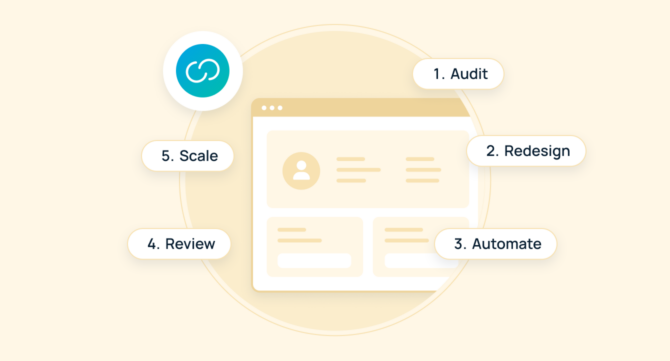
Here’s how I apply both of these principles with clients before we touch a single tool:
Step 1 — Audit the process, not the technology. Document what actually happens, step by step, as it exists today. Not the ideal version — the real one. Where does it break down? Where does it depend on one person’s memory? Where do things fall through the cracks?
Step 2 — Redesign from scratch. Ask: if we were building this today, what would we do differently? Which steps are purely administrative? Which require judgment? Which require institutional knowledge that only lives in someone’s head?
Step 3 — Identify the low-risk, high-repetition tasks first. These are your starting point — rule-based, documented, and repeatable. Give those to AI. Build confidence there before moving into more complex territory.
Step 4 — Build your discernment practice. Establish a review process for AI outputs before they go anywhere consequential. Not forever — but long enough to understand where the tool performs well and where it needs a human check. That data will tell you how much trust to extend and where to hold back.
For most comms teams, that looks like a weekly review of AI-generated drafts before anything ships externally, with a simple log of where the AI got it right and where it needed a human edit.
Step 5 — Expand from a foundation, not a guess. Once you have sound processes and a clear sense of where AI performs reliably, you can start to grow. New use cases, more complex tasks, broader adoption. But the foundation has to come first. Because when the foundation is in place, the math changes.
The Work That Matters
When you do this work upfront, something interesting happens. The hours you save aren’t just recovered — they compound. A task that used to take forty-five minutes gets automated. That forty-five minutes goes somewhere else. Someone who was spending half their day on administrative work suddenly has capacity for the things that actually move the business forward.
That’s what AI is supposed to do. Not replace people — free them up to do work that matters.
But that only happens when the process is sound and the people using the tools have the judgment to use them well. Get both right, and AI delivers on its promise. Skip them, and the technology won’t work for you — it will run ahead of you.
Read more insights from Vernon in our HR GameChangers Episode 19 recap. Hear more from Vernon and other leaders at the front lines of HR and AI in the full HR GameChangers series.