


AI is transforming how organizations access information. It is making knowledge faster to find, easier to summarize, and simpler to act on.
It is also making the people behind that knowledge harder to find.
That tension sits at the heart of a problem most HR leaders recognize but haven’t yet named. As AI scales across the enterprise, employee expertise management — the practice of making human knowledge, skills, and relationships discoverable and actionable — has not kept pace with the tools built around it. Work still flows through people. But the infrastructure to find the right person, at the right moment, for the right decision, hasn’t kept up.
This is the expertise gap. And in the age of AI, closing it may be one of HR’s most consequential opportunities.
AI Scaled the Information Layer. It Left the People Layer Behind.
EY’s Work Reimagined 2025 study found that nearly nine out of ten employees now use AI at work — yet only 28% of organizations are positioned to turn that deployment into high-value outcomes. Organizations have invested heavily in making information accessible. They have not made the same investment in making people accessible. The result: human expertise — the organization’s most valuable resource — remains fragmented, siloed, and undiscoverable even as everything around it gets faster.
Most enterprise AI strategies are built around documents and data — and platforms like GoSearch are making that layer faster and more accessible than ever. Find the right file. Summarize the right report. Surface the right policy. But those strategies consistently miss a layer: people. Who has solved this problem before. Who understands this system. Who made that decision and why. Who can unblock this workflow before it costs the organization another week.
Finding the right document is getting easier. Finding the right person still isn’t.
The Hidden Cost of People Invisibility
When people are hard to find, organizations pay in ways that rarely show up in productivity dashboards.
Work lands with whoever is visible instead of whoever has the expertise. Decisions move forward without the institutional memory to support them. New employees spend months rebuilding context that a single conversation with the right colleague would have provided. And AI agents — increasingly responsible for executing workflows — have nowhere to escalate when they hit the edge of their capability.
Microsoft’s 2025 Work Trend Index found that 80% of the global workforce reports lacking the time or energy to do their jobs well, with nearly half saying their work feels “chaotic and fragmented.” Part of that fragmentation is tool sprawl. But part of it is people sprawl — not knowing who owns what or who can move things forward.
Workers are using AI more and trusting it less. ManpowerGroup’s 2026 Global Talent Barometer found that while regular AI use increased 13% in 2025, confidence in its usefulness dropped 18% over the same period. That erosion of trust is not just about AI quality. It is about the experience of using AI tools that do not understand organizational context.
People visibility isn’t a soft benefit. In the AI era, it’s an operational requirement — and increasingly, a competitive one.
Why This Is an HR Problem — and an HR Opportunity
HR has always owned the people layer of the organization — the connective tissue between roles, teams, and capabilities that makes org design, talent development, onboarding, and succession planning possible.
In many organizations, HR leaders are already extending that ownership into the AI era — bringing people data into the infrastructure for AI-assisted work alongside IT and operations. But the gap is still real. People data too often lives in HRIS systems designed for compliance, not discoverability. Expertise maps, where they exist at all, are static documents that go stale within months of being created.
The result is a structural gap: HR holds the data that would make people discoverable, but that data isn’t always wired into the systems where work actually happens.
HR leaders who close that gap will have a meaningful advantage. As organizations build the search layers, agent frameworks, and workflow systems that AI-assisted work depends on, the HR leaders who bring people data into that architecture will shape how work flows for years to come. AI implementation in HR is already moving at two speeds — and the organizations pulling ahead are the ones treating people visibility as infrastructure, not an afterthought. People visibility is not an IT problem with an HR dependency. It is an HR opportunity with an IT execution path.
What Employee Expertise Management Actually Requires
Making expertise discoverable is not the same as maintaining an org chart. An org chart tells you who reports to whom — not who owns the codebase that needs to change, who resolved the last GDPR request, or who has the history with the client that’s at risk.
Real people visibility requires three things that most organizations currently lack:
Dynamic expertise profiles. Not job titles and tenure dates — accurate, up-to-date records of what people know, what they have worked on, and what problems they have solved. Updated as work happens, not once a year in a performance review cycle.
Relationship and collaboration context. Who works with whom. Who has history with which teams, clients, or systems. The informal network that shapes how work actually moves through an organization is largely invisible in most HR systems — and it’s exactly what AI workflows need to act on reliably.
Discoverability across workflows. An expertise profile that only lives in an HRIS doesn’t reduce the expertise gap. People data needs to be accessible at exactly the right moment: when a decision has to be made, a request has to be routed, or a process has stalled waiting for the right person.
The stakes of getting this right are rising fast. Agentic AI usage is poised to rise sharply in the next two years — but Deloitte’s State of AI in the Enterprise 2026 found that only one in five companies has a mature governance model for autonomous agents. Organizations are at risk of deploying agents that cannot reliably identify, engage, or escalate to the right person when a workflow requires it.
The Expertise Gap Starts on Day One
The expertise gap is visible throughout the employee lifecycle. But nowhere is it more immediately measurable than in onboarding.
A new employee’s time-to-productivity depends less on what they know coming in than on how quickly they can map the organization around them. Who owns what. Who to ask about which system. Who the real decision-makers are. Who has tackled this before and what they learned.
In most organizations, that knowledge is still acquired informally — through persistence, chance introductions, and conversations that are harder to have in hybrid and distributed environments. The result is onboarding that takes longer than it should, with new employees absorbing productivity drag for far longer than organizations realize or measure.
When expertise is discoverable — when a new employee can find the right colleague as easily as they can find the right document — that drag compresses dramatically. The onboarding ROI is immediate. And it compounds: employees who build context faster perform better, stay longer, and contribute more quickly to the organizational knowledge base.
Managers Are Absorbing the Cost of People Invisibility
If new employees feel the expertise gap acutely, managers live it daily.
Most managers spend a disproportionate share of their time on coordination: finding the right person for a task, reconnecting teams that have drifted out of sync, piecing together background that should have carried forward. It’s a systems failure — and it compounds as organizations grow.
As teams grow, work becomes more distributed, and AI generates more parallel workstreams for humans to oversee, managers increasingly become the force holding everything together. Research from Workday finds that nearly 40% of apparent AI productivity gains are lost to rework and coordination overhead, which takes on new meaning when you consider where that overhead actually sits: in the management function, paying the cost of systems that don’t route work to the right people.
For managers, people visibility isn’t a strategy question. It’s a daily operational one.
GoProfiles: Making People as Discoverable as Documents
GoProfiles addresses the expertise gap directly.
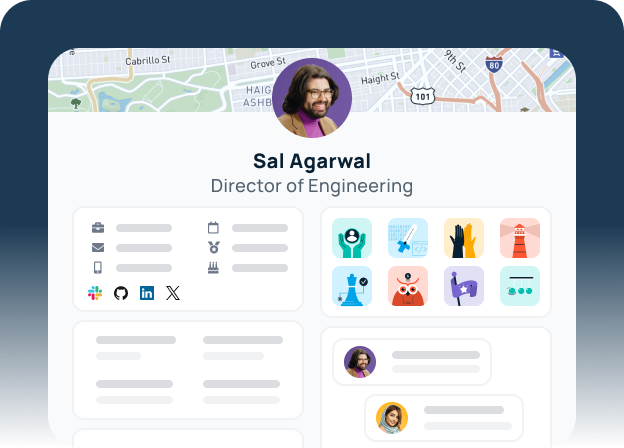
GoProfiles makes the human layer of the organization discoverable — not as a static directory, but as a dynamic, searchable record of expertise, relationships, and context accessible at the right moment. Employees can find who knows what. Managers can route work to the right person without the back-and-forth. AI agents can identify the right human to escalate to when a workflow requires judgment.
Alongside GoSearch’s enterprise knowledge layer — which makes documents, data, and system context accessible across tools — GoProfiles ensures that the full context of the organization is reachable. Not just what the organization knows. But who knows it.
Because in the orchestration era, work still moves through people. The organizations that make their people as discoverable as their documents will have a structural advantage that compounds over time: faster decisions, shorter onboarding, lower coordination overhead, and AI workflows that can navigate the human layer of the organization as reliably as they navigate its data.
What HR Should Do Now
The expertise gap won’t close on its own — and it will widen as AI scales. GoProfiles’ State of HR 2026 Report finds that people visibility is emerging as one of the defining infrastructure challenges for HR — and that the organizations moving fastest are the ones treating it as an operational priority, not a future initiative. Here is where HR can act:
Audit your people visibility infrastructure. Not your HRIS. Your discoverability. Can employees find the right colleague when it matters? Can AI workflows identify the right human to escalate to? If the answer is no, the expertise gap is already costing you — you’re just not measuring it yet.
Claim a seat in the AI infrastructure conversation. People visibility is not an HR nice-to-have. It is an operational requirement for AI-assisted work. HR leaders who engage with IT and operations on how people data gets wired into AI workflows will shape the outcome. Those who wait will inherit it.
Treat expertise profiles as living infrastructure, not periodic reporting. Static org charts and annual skills inventories do not close the expertise gap. Dynamic profiles that update as work happens — and travel with it — do.
Measure time-to-expertise, not just time-to-productivity. The real indicator of onboarding success isn’t when a new employee completes their first deliverable. It’s when they can find the right person, ask the right question, and act without hesitation. That’s a measurable milestone — and most organizations don’t track it.
The Best AI Strategy Still Depends on Finding the Right Person
AI is making information more accessible. It isn’t automatically making people more visible.
That gap — between what organizations know and who knows it — is where the AI productivity promise breaks down. Work stalls not because the data is missing, but because the right person is hard to find. Decisions lag not because the information doesn’t exist, but because the institutional memory to act on it is out of reach.
Closing the expertise gap isn’t an IT initiative. It’s a people strategy — and one HR is uniquely positioned to lead.
The organizations that treat employee expertise management as seriously as they treat enterprise search or workflow automation will find their AI investments perform materially better as a result.
Because the best AI strategy in the world still depends on finding the right person.
See how GoProfiles makes your organization’s expertise discoverable. Book a demo →
Build a culture of connection and recognition with GoProfiles
Schedule a demo