Need a little productivity boost? Join our monthly newsletter and we’ll go/link you to the latest tips and trends in tech!
Leadership is no longer defined by stability, predictability, or linear growth — it’s being reshaped by constant change, accelerating technology, and evolving employee expectations. As organizations navigate ongoing disruption, leaders must reset how they build resilience, trust, and connection in workplaces that are increasingly digital, distributed, and AI-enabled. The question isn’t whether leadership must evolve — it’s how leaders can adapt fast enough to remain effective, human-centered, and future-ready in 2026 and beyond.
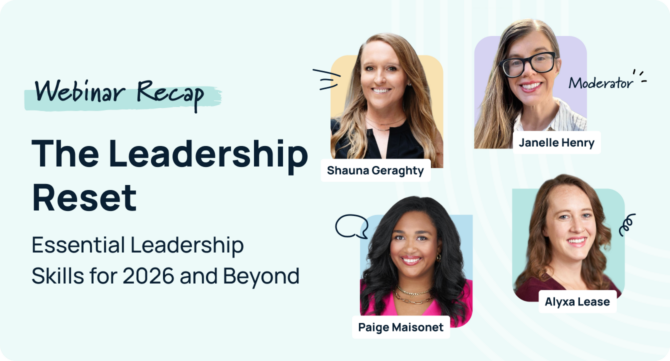
In a recent GoProfiles HR GameChangers panel, senior people leaders from Talkdesk, Newfront, and Articore shared how they’re redefining leadership for a new era — spanning resilience, inclusivity, digital empathy, boundary setting, and AI-driven transformation. Moderated by Janelle Henry, Talent and Brand at Stripe, the conversation explored the mindsets, behaviors, and practical strategies leaders need to navigate uncertainty, empower teams, and build organizations that can thrive amid rapid change.
For more HR technology insights, check out our previous episodes:
And if you’re not registered for the series, you can register here. And follow us on LinkedIn to never miss a moment!
Speakers
Janelle Henry: Talent and Brand at Stripe, Advisor & Former VP of People at Rad AI & GoProfiles customer (moderator)
Shauna Geraghty: SVP of People & Talent, Talkdesk
Paige Maisonet: Chief People Officer, Newfront
Alyxa Lease: SVP of People & Culture, Articore
Key Takeaways:
Resilience requires transparency: Leaders build trust by communicating early, naming uncertainty, and showing vulnerability.
Compassion + clarity drive stability: Balancing empathy with decisive direction helps teams stay grounded amid constant change.
Inclusive leadership demands action: True inclusion requires systems that elevate diverse perspectives, normalize dissent, and encourage psychological safety.
Connection must be intentional: In hybrid environments, leaders must design communication and meeting norms that fully include remote employees.
Boundaries protect performance: Modeling healthy work habits, encouraging recovery, and setting clear norms prevent burnout and sustain long-term impact.
AI unlocks strategic capacity: Leaders who embrace AI are reclaiming hours each week to focus on higher-value, strategic work.
Adaptability is the new advantage: Future-ready leaders prioritize continuous learning, experimentation, and rapid skill development.
Empowerment beats protection: Shifting from shielding teams to enabling ownership builds stronger, more resilient organizations.
Resilient Leadership Starts with Transparency, Not Control
In 2026, leadership is no longer about having all the answers — it’s about showing up with clarity, vulnerability, and trust when certainty is impossible.
“Sometimes the most powerful update is saying: I don’t have all the answers yet — but I’m here.”
—Janelle Henry, Talent and Brand at Stripe, Advisor & Former VP of People at Rad AI
When change is constant, it’s easy for leaders to either retreat or tighten control. But neither approach builds trust. Resilient leaders show up, communicate early, and name uncertainty with transparency.
Shauna emphasized that stability doesn’t come from predictability — it comes from trust.
“When leaders communicate early, even without perfect answers, they create psychological safety. That’s what helps teams stay grounded through change.”
—Shauna Geraghty, SVP, Global Head of People and Talent, Talkdesk
Alyxa reinforced that resilience is built through compassion plus clarity — caring deeply about employee experience while remaining decisive about direction.
“Compassion without clarity creates confusion. Clarity without compassion creates fear. Leaders need both.”
—Alyxa Lease, SVP of People & Culture, Articore
Paige emphasized that emotional regulation is contagious — when leaders remain calm, transparent, and grounded, their teams tend to follow. In today’s environment, resilience isn’t about certainty; it’s about presence.
Inclusive Leadership Means Designing for Every Voice
Most leaders value inclusion. But meaningful inclusion doesn’t happen through intention alone — it requires systems, structure, and deliberate design.
“Inclusive leadership means acting on diverse perspectives — not just listening to them.”
—Alyxa Lease, SVP of People & Culture, Articore
Across the panel, leaders emphasized that inclusion scales through process, not personality. Practical techniques included:
Asking the most junior team member to speak first
Assigning someone to take the opposing viewpoint
Sending pre-reads and collecting async feedback
Following up one-on-one to invite quieter voices
“Inspecting silence” — intentionally checking in when someone isn’t speaking
Paige highlighted the importance of valuing both loud and quiet leadership styles:
“Some people lead through volume, others through insight. Inclusive leaders make space for both.”
—Paige Maisonet, Chief People Officer, Newfront
Shauna emphasized that healthy conflict is a core part of inclusion, not something to avoid. Psychological safety doesn’t mean agreement — it means creating an environment where people feel safe to challenge ideas, voice dissent, and contribute openly.
True inclusion happens when organizations engineer participation, not just invite it.
Digital Empathy: Building Trust in Hybrid & Remote Teams
Shauna emphasized that as teams become more distributed, leaders must rethink how they communicate. Without body language and informal interactions, trust depends on clarity, consistency, and transparency. Standardized communication norms and regular check-ins help ensure alignment and reduce misunderstanding.
Alyxa highlighted the importance of human connection, encouraging leaders to know employees as people, not just performers. Regular one-on-ones, visible leadership, and genuine interest in employees’ lives build trust and strengthen relationships across distance.
Paige added that inclusive meeting design is essential. Clear facilitation, thoughtful camera norms, and intentional participation ensure remote employees feel fully seen, heard, and valued.
Connection doesn’t just happen — leaders have to create it.
Boundary Setting: Protecting Energy in Always-On Work Cultures
With work now living in our homes, phones, and pockets, leaders must actively model boundaries — not just encourage them.
Shauna shared how her team intentionally builds recovery periods after intense work sprints, reinforcing that rest is just as strategic as execution. Creating space for downtime helps prevent burnout and sustain long-term performance.
“We work hard — and we recover hard. Rest is a performance strategy.”
—Shauna Geraghty, SVP, Global Head of People and Talent, Talkdesk
Leaders also set the tone through their own behavior. Simple actions — like avoiding early-morning emails, respecting time zones, and clearly communicating availability — help teams feel safe setting healthy boundaries.
Paige highlighted several practical tactics that make a real difference:
Creating physical separation between work and home
Turning off mobile notifications
Using delayed send features
Setting clear response expectations
Healthy boundaries don’t reduce accountability — they sustain performance.
When asked which leadership skill will matter most in 2026, 56% of HR leaders in attendance chose setting healthy boundaries while driving performance — signaling a shift toward sustainable, human-centered leadership.As AI accelerates change, leaders who model balance and adapt quickly will be best positioned for long-term success.
AI Is Rewriting Leadership Work — And Freeing Strategic Capacity
Shauna shared that AI has freed up meaningful time, allowing her to spend more energy on strategic work.
“AI has completely reshaped my role — in the best way.”
—Shauna Geraghty, SVP, Global Head of People and Talent, Talkdesk
She also noted a growing gap in AI adoption, driven by organizations that rethink workflows more holistically. Those moving fastest are actively experimenting, learning, and redesigning how work gets done — building momentum while others fall behind. AI isn’t replacing leadership — it’s amplifying it.
Future-Ready Leadership Means Becoming an Expert Learner
In an environment where skills constantly evolve, adaptability has become a defining leadership advantage.
Alyxa emphasized that future-ready leaders balance rapid adaptation with long-term thinking — staying focused on today while planning for what’s next. Paige highlighted vulnerability as a leadership accelerator, noting that openness and humility build trust. Shauna framed this shift through the mindset of becoming an expert learner — someone committed to learning faster than change itself.
“You don’t need all the answers. Being open about what you don’t know builds trust.”
—Paige Maisonet, Chief People Officer, Newfront
In 2026, leadership credibility comes not from certainty — but from curiosity, humility, and learning velocity.
What Leaders Must Unlearn to Thrive in 2026
The panel closed with a reflection on leadership behaviors that once worked — but now need to evolve.
Shauna shared that early in her leadership journey, she felt pressure to shield her team from stress and uncertainty. Over time, she realized this approach led to burnout and limited growth, shifting instead toward empowering teams with ownership and accountability.
Paige emphasized that leadership is moving away from technical mastery and toward influence, engagement, and trust-building — rallying people around shared goals rather than being the subject-matter expert.
Alyxa challenged the idea that leaders need to be universally liked, highlighting that meaningful leadership is rooted in impact,.
“Leadership isn’t about being likable — it’s about unlocking potential.”
—Alyxa Lease, SVP of People & Culture, Articore
Final Thoughts: Leadership Is Being Reset — Not Replaced
The defining leadership skills of 2026 aren’t control, expertise, or predictability. They are resilience, empathy, inclusion, boundary clarity, AI fluency, and continuous learning.
As organizations accelerate AI adoption and workforce transformation, leadership itself must evolve. Those who embrace this reset will shape the future of work.
Build the people foundation your organization needs for what’s next. Discover how GoProfiles helps HR teams strengthen visibility, connection, and engagement across every team.
Build a culture of connection and recognition with GoProfiles
Join us as we discuss how to integrate AI readiness into performance management, and align goals, metrics, and expectations with the next phase of workforce transformation.