Need a little productivity boost? Join our monthly newsletter and we’ll go/link you to the latest tips and trends in tech!
It’s no longer whether AI belongs in your organization — it’s whether your leaders are ready to lead through the transformation. That distinction matters more than most succession plans currently account for. The capabilities that made someone an exceptional leader five years ago haven’t disappeared, but they’ve been reordered. The skills that matter most now are the ones hardest to automate — and the roles you’re planning for today are already changing faster than most pipelines can track.
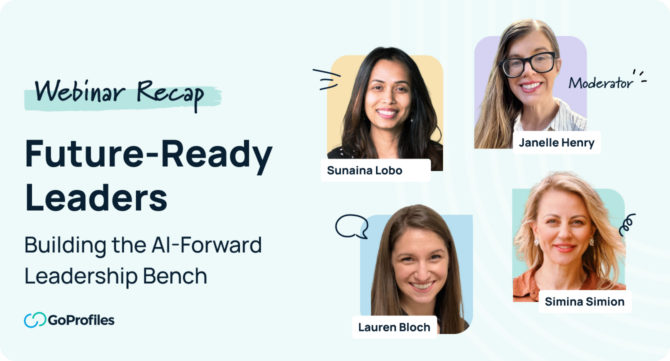
In Episode 20 of the GoProfiles HR GameChangers series, a panel of people executives joined moderator Janelle Henry to tackle what it actually takes to build a future-ready leadership bench — from redefining leadership readiness and rethinking succession, to supporting employees through the shift and leading by example within their own teams.
For more HR technology insights, check out our previous episodes:
Soft skills are the new hard skills — curiosity, ethical judgment, and empathy are no longer nice-to-haves; they’re the capabilities that hold their value no matter how much the technology changes.
Experimentation is a starting point, not a strategy — tie AI adoption to specific outcomes and measure against them.
Deploy AI for your people, not at them — employees are watching what leaders do, not just what they say.
Succession planning is a capability question first — and with roles changing faster than pipelines, getting that right is critical.
Peer-to-peer learning is the most current AI curriculum you have — what’s happening inside your teams will always outpace what any platform can offer.
The Skills That Can’t Be Automated
One theme surfaced early and ran through the entire conversation: the skills once filed under “soft” are now the hardest to build and the least replaceable. Technical ability can be augmented. Judgment can’t.
“The things that have surfaced in our work around succession and leadership development are behaviors we used to call soft skills — they’re the new hard skills. Things like connection, curiosity, learning — and having a conscience about how you think about ethical AI and its impact on people, processes, organizations, and the world.”
—Sunaina Lobo, Chief People Officer, Omnissa
Lauren Bloch added two capabilities she sees as specific to this moment: change management and systems thinking. Not the textbook versions — the first means a willingness to experiment and tolerate ambiguity; the second means connecting data sources and workflows that once lived in isolation into a coherent, organization-wide picture.
“A real systems thinker is thinking about how we connect an entire ecosystem and organization.”
—Lauren Bloch, Chief People Officer, Movable Ink
How to Spot a Leader Who’s Ready
How do you avoid over-indexing on AI enthusiasts — the people jumping in loudest, generating the most output — while not missing the leaders who are quietly excelling at the harder, more durable things?
Simina Simion reframed the question entirely. The signals she watches have less to do with tool usage and more to do with the quality of thinking beneath it.
“How fast can someone update their mental model based on new data? How good is someone at asking questions, not just providing answers? Their willingness to be wrong in public when it costs them something. Willingness to take full responsibility for the output of AI. How comfortable they are leading when we’re entering uncharted territories.”
—Simina Simion, Chief Human Resources Officer, Uptempo
Lauren’s approach is tactical. Rather than telling everyone to experiment freely, her team is working business unit by business unit — identifying the specific problems they want AI to solve first, then building scorecards to measure against actual outcomes. Experimentation is welcome, but only in service of something.
“We’re not incentivizing token usage. We want experimentation in service of specific outcomes.”
—Lauren Bloch, Chief People Officer, Movable Ink
Employee Anxiety Is Real. The Reasons Are Nuanced.
When Lauren ran a listening tour across her organization to take the temperature on AI adoption, she expected to hear anxiety about job security. What she found was more nuanced. People didn’t know where to start. They worried about losing their ability to think independently if AI did too much of the cognitive work. And they didn’t have the bandwidth to learn something new on top of everything else they were already carrying.
Her prescription: peer-to-peer learning. The most current AI curriculum, she argued, isn’t sitting on any platform — it’s already happening inside your teams.
Sunaina’s message to her organization has been consistent: this is about developing people, not replacing them. The old leadership model rewarded having all the answers. The new one rewards asking good questions and staying curious.
“If we can get to the point where we’re focused on developing rather than replacing — that’s the message. We want to enable, we want to develop, we want to promote a culture of learning and of not having to have all the answers.”
—Sunaina Lobo, Chief People Officer, Omnissa
Simina was more pointed: employees aren’t listening to what leaders say — they’re watching what leaders do.
“If you’re saying one thing, but then you deploy AI at the employees instead of for the employees, it becomes obvious in the organizational culture.”
—Simina Simion, Chief Human Resources Officer, Uptempo
Succession Planning for Roles That Don’t Exist Yet
Traditional succession planning assumed relative stability: a role opens, someone steps in, the function continues. That assumption is no longer reliable.
Simina now thinks in two tracks. The first: the stretch successor — the high-potential candidate who can step into a role as it currently exists. The second: the wild card — someone who may not look like the obvious choice today but is best positioned for where the role is heading in one to two years.
Sunaina offered a counterpoint to the idea that AI requires succession planning to be reinvented from scratch. Capability-based succession, done well, has always been technology-proof. AI has accelerated one thing: the urgency to update which capabilities matter — and to shift from rewarding the smartest person in the room in favor of developing everyone in it.
“We’re starting our succession framework from scratch — being technology-agnostic, promoting talent producers, developing utility players rather than people locked into hierarchical moves within a single function.”
—Sunaina Lobo, Chief People Officer, Omnissa
Building a Framework for Responsible Deployment
Lauren’s approach centers on a cross-functional AI council — legal, security, executive leadership, and deep technical expertise all in the room together. Guidelines are built collaboratively, reviewed on a regular cadence, and updated as the tooling evolves.
The global picture added another layer. For parts of her global workforce, deploying an AI tool requires going through a formal employee review process — which initially sounded like a constraint. It turned out to be the opposite: a forcing function for clearer thinking about outcomes, more intentional communication, and a more empathetic lens on how tools get rolled out to employees.
Keeping Leadership Development From Going Stale
One of the sharpest audience questions of the episode: how do you keep leadership development programs from going stale when AI is evolving faster than any curriculum can track?
Simina laid out three tactics. First: a leadership accelerator that embeds AI into every module — not as a subject to cover, but as a tool to actually use between sessions. Second: democratized access to executive coaching, after recognizing that many leaders weren’t comfortable raising their AI anxiety in organizational channels. Third: a deliberate expansion of who gets the training at all.
“We can’t optimize leadership training only based on where someone sits on the org chart. In the new world, someone in a CS role using AI to solve a critical customer escalation is becoming a decision-maker and a leader. I’m planning to deploy this training to everyone in the organization.”
—Simina Simion, Chief Human Resources Officer, Uptempo
HR, Apply It to Yourself First
Lauren challenged every member of her HR team to build a bot. The requirement was simple: build something — anything. From that exercise came real use cases: onboarding automation in Slack, smarter recruiting scorecards, automated job descriptions. Her longer-term ambition is an HR MCP connecting all the disparate systems so managers get genuinely customized, real-time support.
For Simina, the starting point was deliberately low-tech: a spreadsheet shared with her whole team. Every project and task rated by how excited versus how drained each person felt doing it. The output was a map of which work was worth automating — freeing the team to focus on what was energizing and strategic.
“I asked my team to rate which tasks they’re most excited about — and which ones drain them. Then: what if we use AI to automate the draining parts, so we can focus on the work that’s actually energizing?”
—Simina Simion, Chief Human Resources Officer, Uptempo
The closing note from both was the same: it sounds easier than it is. Connections break. Bots give wrong advice. Agents need more hand-holding than anyone advertises.
“It takes a lot of time. No one talks about the trial and error — the hours spent fine-tuning agents and skills to work the way you expect them to.”
—Simina Simion, Chief Human Resources Officer, Uptempo
“That’s where judgment comes in — you still need to be there to tell AI: you’re wrong.”
—Lauren Bloch, Chief People Officer, Movable Ink
What Future-Ready Leadership Actually Looks Like
The leaders who will thrive in an AI-transformed organization aren’t necessarily the most technically sophisticated. They’re the ones who update their mental models quickly, ask better questions than they provide answers, take full ownership of AI’s outputs, and build cultures of trust rather than climates of anxiety.
That profile — curious, accountable, human — doesn’t expire when the tools change. The bench you build around it now is the one that will still be ready when the roles look nothing like they do today.
Emily Deuser is Content Manager at GoLinks, GoSearch, and GoProfiles, where she helps enterprise teams cut through the noise around workplace AI and find tools that actually make knowledge accessible. She specializes in turning complex productivity challenges into clear, actionable guidance that helps teams work smarter every day.
Engagement shows whether people want to do great work. Employee enablement shows whether they can. In Episode 24 of HR GameChangers, people leaders share how HR can close that gap.