Need a little productivity boost? Join our monthly newsletter and we’ll go/link you to the latest tips and trends in tech!
Two companies roll out identical AI tools this quarter. Six months later, one has employees who trust leadership more than ever. The other has slipping morale and rising turnover. The difference was never the technology — it was the trust each company had already earned before the rollout began. AI doesn’t create a trust gap. It exposes the one already there.
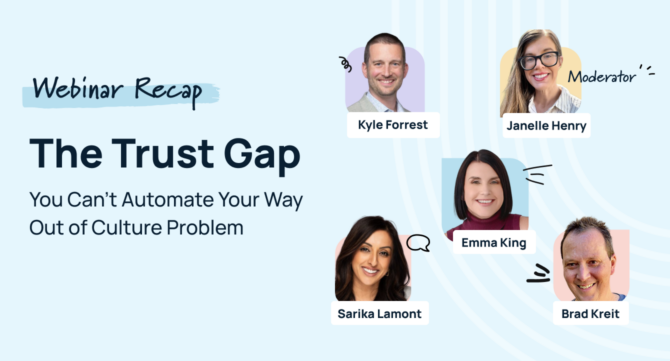
In Episode 23 of the GoProfiles HR GameChangers series, moderator Janelle Henry was joined by leading voices in the future of work to examine what AI is actually doing to employee trust — why the rollout narrative carries more weight than the tooling, what employees are really worried about underneath the surface, and how to design a workweek that gives people room to learn.
Brad Kreit: Research Leader, Deloitte Center for Integrated Research
Key Takeaways:
AI didn’t create your trust problem —it magnified the one you already had. Organizations with clear expectations and established credibility see AI strengthen culture. Organizations without them watch it accelerate the erosion.
Silence is a position — and employees will interpret it. The companies seeing sentiment rise took an explicit stance. The ones seeing it fall said nothing and let the headlines fill the gap.
Trust is local, not transferable — the same rollout approach that works after years of built-up credibility will not work when you’re new to the organization. Where you start depends entirely on what you’ve already earned
Culture debt accrues like technical debt — skip the behavioral work during rollout and the interest compounds. Recognition, reward, and manager habits all have to move with the tooling.
Give people the pen — employees who help design the change stop resisting it. Telling someone their role will change without involving them in how is the fastest route to resistance.
Time is the real blocker — for many employees, the barrier isn’t willingness, it’s a full calendar. Unscheduled learning doesn’t happen.
Measure outcomes, not tokens — license activation is a starting metric, not a success metric. Track what each team actually delivers with AI — tickets resolved without a human, pipeline generated per rep.
Silence Is the Riskiest Position on AI
Across companies rolling out AI right now, a clear spectrum has emerged. At one end are the organizations investing openly and promising no role impact. At the other are the ones being blunt: we don’t know what happens to this work, we can’t guarantee your job, and if you won’t learn this, we’re not the right fit. Both ends build trust because both are transparent. It’s the silence in between that leaves employees guessing.
“It starts with a very clear narrative: why are we doing this, what do we expect the business outcome to be, and what does that mean for your role?”
—Kyle Forrest, Future of HR Leader, Deloitte
The narrative gap is what employees fill with speculation. Kyle Forrest, Future of HR Leader at Deloitte, traced how the AI conversation has moved from feature-and-function debates a few years ago to something closer to a reputation problem — driven by sweeping public claims about white-collar work disappearing. He pushed back on the premise: the compute doesn’t exist, the data centers aren’t built for it, and nobody actually wants an outcome where people lose the income that funds their communities. But the claims are still out there, and employees are hearing them even when they aren’t coming from inside your organization.
Emma King, Chief People and Culture Officer at Envoy, argued that none of this is new.
“I don’t think AI has created new trust issues. I think it’s acting as a massive magnifying glass on the trust issues that were already there.”
—Emma King, Chief People and Culture Officer, Envoy
That distinction reframes the whole exercise. Employees aren’t evaluating a technology in the abstract. They’re evaluating the judgment of the people deploying it. Which means the goal was never to get employees to trust AI. It’s to give them reasons to trust how you’re choosing to use it.
Where You Start Depends on What You’ve Earned
Sarika Lamont, Chief People and AI Enablement Officer at TechnoMile, has now led multiple AI enablement initiatives, and the contrast between them is instructive. In one, she had years of credibility banked before AI arrived. She knew the personas, knew who her change agents would be, knew who would push back and demand specifics. That let her lead with radical openness — laying out what she knew, what she didn’t, and what came next.
“I think we as executives assume we have to have all the answers. What I’ve learned is that we actually don’t.”
—Sarika Lamont, Chief People and AI Enablement Officer, TechnoMile
Without that trust already in place, none of that applies. If the foundation isn’t there yet, moving slowly is a choice, not a failure. Small-group conversations first. The company-wide version comes later.
Her takeaway was that there is no universal approach. What works depends on the trust you’ve built, the people you’re working with, and what the business is going through — and those change from one organization to the next.
Janelle Henry, Talent and Brand at Stripe, shared a story of a recent vendor pitch offering to show her what everyone else was doing to solve AI and hiring. Her response was that no such playbook exists — nobody has solved it yet.
“If we’re looking around trying to find what everyone else is doing, it’s outdated information in ten seconds.”
—Janelle Henry, Talent and Brand, Stripe
What Employees Are Actually Worried About
A live poll during the session asked attendees to name the biggest threat to employee trust as AI reshapes the workplace. The results defied the headlines:
Rapid changes to roles and responsibilities — 50%
Lack of transparency from leadership — 25%
Layoffs and restructuring — 17%
Fear of job displacement — 8%
Displacement finished last. What people are reacting to is churn and opacity — the sense that the job is being redrawn faster than anyone explains why.
That maps closely to what the panel described hearing internally. Emma named some of the questions she hears from employees: Is this going to replace me? Will I lose the parts of my role I enjoy? Am I just going to be checking a machine’s output?
Sarika pointed to a core change-management principle to explain why: employees need to know what’s in it for them. But she found the worry ran well past job security. Her younger employees raised concerns about environmental impact, water consumption, and data center construction. They asked what AI would do to future entry-level jobs, and, eventually, to their kids’ jobs.
Brad Kreit, Research Leader for the Future of Work at Deloitte, described what sits beneath those questions. In a study his team is completing now, workers report feeling reasonably confident about their day-to-day work. But the markers of uncertainty show up just below that confidence — not doubt about whether they can do the job today, but about whether today’s job is the one that will still matter.
“We have to plan for a lot of uncertainty, and by the time we know what the answer will be, it’s too late.”
—Brad Kreit, Research Leader, Future of Work, Deloitte
His answer is scenario planning. Rather than betting on one forecast, map several plausible futures and make choices that hold up across all of them.
“I can learn the new skills, I can get the certification, I can check all the boxes, and I still won’t know if that’s right.”
—Brad Kreit, Research Leader, Future of Work, Deloitte
Kyle offered an example of what happens without that intention. AI was supposed to give people time back. Instead, many are working more, not less. Deloitte’s 2026 Global Human Capital Trends report ended this year on exactly that point: the decisions being made right now determine which version of the future actually arrives.
“If we believe AI should give time back to people, we need to design the workday now so that nobody has to wake up at 4 a.m. to check that their agents kept doing what they were supposed to do.”
—Kyle Forrest, Future of HR Leader, Deloitte
Culture Debt Is Real, and It Compounds
Asked where AI improves culture and where it creates distance, Kyle drew on the same report’s chapter on AI’s cultural debt: skip the culture work during a rollout and you accumulate culture debt exactly the way you accumulate technical debt.
“If you aren’t clear about addressing culture-related things as you roll out AI, you can build up culture debt the same way you can build up technical debt in a company.”
—Kyle Forrest, Future of HR Leader, Deloitte
Paying it down is unglamorous work. Team members rotating through what they tried and where they got stuck. Recognition and rewards that shift alongside the tooling, not one hackathon a year. And a ready answer for what happens to the hours AI frees up, because that’s the question employees ask next.
Emma cited Gallup’s Q1 2026 workforce study: among employees at organizations that have implemented AI, 24% said their culture improved over the past year and 25% said it worsened. To her, the split proves the point: AI isn’t the deciding factor. Where leadership is strong, expectations are clear, and trust already exists, AI strengthens the culture. Where those are missing, it accelerates the decline.
Sarika has seen AI push culture in the right direction, and she was specific about why. The AI rollout ran out of the people function rather than engineering, which kept every decision anchored to employee impact. Senior leaders weren’t exempt from demonstrating their own use — including a top executive admitting publicly that something they’d presented was unusable.
“We as leaders have to practice what we preach. I can’t expect ICs to lean into something that’s making them really nervous if they don’t see us doing that same thing from the very top.”
—Sarika Lamont, Chief People and AI Enablement Officer, TechnoMile
Janelle offered a version of the same practice from her own team: an image-generation contest where the worst results were the point.
“Show your learning, show your math, open up the notebook. I believe that builds so much trust.”
—Janelle Henry, Talent and Brand, Stripe
Audience members weighed in with their own experiences. One described building an internal tool with AI workflows embedded, filling a gap the existing stack couldn’t and delivering real gains in consistency for managers and HR alike.
Resistance Is Usually a Design Problem
Every panelist landed on the same answer: participation is what turns a mandate into adoption.
“Employees have to participate in the change. Bring them along, give them the pen. Involve them. Help them shape the role.”
—Emma King, Chief People and Culture Officer, Envoy
Kyle noted how much of a shift this represents at the individual level. Improving how work gets done used to be someone else’s job. The expectation now is that every employee continuously redesigns their own role, which is a substantial ask to make without support.
Brad’s data suggests the appetite is there. In his team’s research, a majority of respondents agreed AI can support upskilling, with 25- to 34-year-olds the most likely to say so. Early-career employees are looking for a story about acceleration. Without one, they get headlines about worthless degrees instead.
Sarika was candid that participation runs both ways. The organization invests in enablement and builds the ecosystem, but development stays the individual’s responsibility, and outcomes eventually show up in performance reviews. Some leaders were surprised she’d say it out loud. Her view was that clarity is kindness — and most employees appreciated the directness.
Nobody Has Time to Learn AI
In Brad’s research, the biggest blocker wasn’t reluctance. It was employees with no free time to learn anything. Enablement is a calendar problem before it’s a curriculum problem.
Kyle compared it to return-to-office mandates, where “three days a week” failed on the obvious follow-up: which days, and why? Learning needs that same specificity. A day a month with calendars cleared, or an hour every morning — either works. Most organizations pick neither, and the learning gets pushed into whatever time employees can find on their own.
“Giving people the time to learn, giving people the time to experiment and make mistakes, and helping build confidence. It doesn’t have to be perfect, but we’re going to learn together.”
—Emma King, Chief People and Culture Officer, Envoy
Sarika’s answer was a recurring monthly session with topics sourced entirely from employees, starting at an introductory level and advancing as the group’s fluency grew. From there it expanded into open office hours, where people dropped in to problem-solve or simply listened to someone else’s problem. As the program matured, it moved again, into function-specific hackathons.
None of this is one-and-done. Some companies now run AI 101 every year, because what counts as “101” keeps moving. Zapier’s AI fluency rubric, which Kyle pointed the audience to, shows how far a starting point can travel in a year.
Measure Outcomes, Not Tokens
Sarika tracked usage for the first six months — how many licenses were activated, whether everyone had equitable access, who wasn’t logging in and why. Those were the right questions early. They were never proof the investment was working.
“I’d never go to the board and tell them about my usage and my licenses. They don’t care about that.”
—Sarika Lamont, Chief People and AI Enablement Officer, TechnoMile
The alternative is function-specific KPIs. She offered two examples: in IT and technical support, the share of tickets auto-closed without a human in the loop; in sales, pipeline created per rep attributable to AI usage.
The measurement gap runs deeper than metric selection, though. Brad returned to the investment split behind most AI strategies, drawn from Deloitte’s Tech Trends 2026 report: roughly 93% of AI spend goes to the technology, and about 7% to people and skills.
“The more you can view those as connected investments, putting money against both things, the more successful you’re likely to be.”
—Brad Kreit, Research Leader, Future of Work, Deloitte
What Trust Actually Requires
In his closing remarks, Kyle offered a framework from a Deloitte colleague’s research into what actually drives trust — four dimensions that double as a diagnostic for any AI rollout:
Humanity — are you showing up empathetic to the moment?
Reliability — you do what you say you’ll do
Capability — you deliver a quality experience
Transparency — you use simple, easy-to-understand language
Emma expanded on that, adding a fifth test of her own.
“Make sure the benefits of AI are felt by employees, not just the business.”
—Emma King, Chief People and Culture Officer, Envoy
And Sarika returned to where she started, with the question that anchors every decision worth making.
“Continue to anchor anything you do around AI transformation on what’s in it for the employee.”
—Sarika Lamont, Chief People and AI Enablement Officer, TechnoMile
The Trust Gap Is a Leadership Gap
The gap isn’t between employees and AI. It’s between employees and the people deciding how AI gets used, which means leaders can close it with the tools they already have: a narrative that explains the why, honesty about the unknowns, room in the week to learn, and metrics that show whether it worked.
An organization with existing credibility, clear expectations, and leaders willing to show their own work will come through the AI transition stronger.
For More HR Technology Insights, Check Out Our Previous Episodes:
Join us as we explore what high performance means once AI is embedded in daily work — and how HR leaders are building the enablement systems that get teams there.
Emily Deuser is Content Manager at GoLinks, GoSearch, and GoProfiles, where she helps enterprise teams cut through the noise around workplace AI and find tools that actually make knowledge accessible. She specializes in turning complex productivity challenges into clear, actionable guidance that helps teams work smarter every day.
Engagement shows whether people want to do great work. Employee enablement shows whether they can. In Episode 24 of HR GameChangers, people leaders share how HR can close that gap.