Need a little productivity boost? Join our monthly newsletter and we’ll go/link you to the latest tips and trends in tech!
An engaged employee who can’t find the information they need, doesn’t know which priorities come first, or is stuck in a tool that slows them down is still an engaged employee. They just aren’t performing. Many HR teams look to engagement scores as the primary signal of workplace health. But motivation alone doesn’t move the business forward. More people leaders are shifting their focus from how employees feel about work to what stands in the way of doing it well.
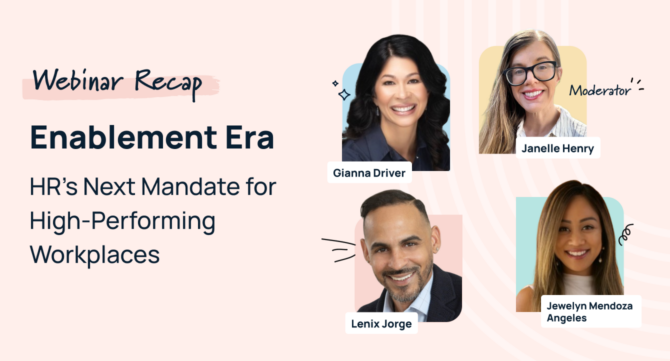
In Episode 24 of the GoProfiles HR GameChangers series, moderator Janelle Henry and a panel of people leaders explored why enablement is becoming HR’s next mandate. The discussion ranged from measuring enablement beyond the annual survey and supporting managers with fewer resources to using AI where it actually helps and rethinking tools that make work harder.
Measure beyond sentiment. Engagement surveys show whether people want to do their best work, not whether they can. Pair them with operating data like time to productivity, self-service rates, and process cycle times to find where work slows and what’s getting in the way.
Equip managers first. Managers carry an outsized share of responsibility for team performance, often with shrinking support. Cohort-based learning builds skills and peer networks at the same time.
Own the output. AI amplifies good judgment and bad habits alike. Work that ships without human oversight adds noise instead of value.
Map real workflows. Employee experience should reflect how teams actually work. Standardize where scale requires it and personalize where roles require it.
Give tools time. Every new system brings a dip in productivity before it pays off. If it’s still not working after a few months, listen to users and adjust.
Engagement Is the Starting Point, Not the Finish Line
Engagement surveys aren’t going anywhere, and no one on the panel argued they should. Engagement still deserves a place on the scorecard, but it loses its value when organizations treat it as the end goal instead of the first step.
Gianna Driver, Chief People Officer at One Workplace, put it simply: Someone can be fully engaged and still focused on the wrong things. A strong engagement score tells leaders that people want to contribute. It says nothing about whether they have the clarity, tools, and support to follow through. That gap is where enablement comes in.
“Engagement is the starting place. Then we move to enablement, because that ensures our teams have what they need to be successful and drive business outcomes.”
—Gianna Driver, Chief People Officer, One Workplace
Jewelyn Mendoza Angeles, Former VP of People & Culture at Poshmark, boiled the distinction down to two questions. Engagement asks whether employees want to do their best work. Enablement asks whether they can. Performance is the payoff when the answer to both is yes, and it’s the result the business actually cares about.
That shift also changes HR’s job. Lenix Jorge, VP of People Operations, Systems & Programs at One Workplace, sees HR moving beyond collecting survey results and handing off action plans. Instead, it works alongside leaders to build the support each team needs, shifting from reporting on sentiment to removing obstacles.
Clarity Is the First Barrier to Performance
Ask what keeps engaged employees from performing, and the answer often isn’t motivation or skill. For Jewelyn, it’s a problem that predates AI but has become more pressing because of it.
“For me, the biggest friction point I’ve seen is clarity. Everyone’s working so fast, but do people actually understand what really matters?”
—Jewelyn Mendoza Angeles, Former VP of People & Culture, Poshmark
Teams are asked to deliver faster with leaner resources, and AI adds more context to every decision. But more information doesn’t mean more clarity. Leaders still have to distill it into a few clear priorities that drive business results.
AI widens that gap. Lenix hears the same questions from many employees: What’s expected of me? How does my manager want me to use these tools? What does this mean for my role? Increasingly, they look to HR to help answer them.
But clarity on its own isn’t enough. Gianna named two more requirements: the right systems, tools, and processes, and a culture where people feel safe admitting they’re confused or uneasy about a new AI tool. Without both, even well-defined priorities stall.
Enablement Shows Up in Operating Data
Surveys capture how people feel about their work. Enablement shows up in the work itself: how long tasks take, where requests pile up, and what slows people down.
Much of that data may already exist. At Poshmark, Jewelyn’s team tracked manager effectiveness and access to information alongside eNPS and intent to stay, without necessarily calling it enablement. Measuring more intentionally means asking harder operational questions, such as how many support tickets ask for answers employees could find on their own.
“If people say information is difficult to find, how long does it actually take? Measure that.”
—Jewelyn Mendoza Angeles, Former VP of People & Culture, Poshmark
Gianna added attrition reasons and referral rates, since people who feel set up to succeed tend to recommend their employer. She also championed small-group conversations and town halls, even though they’re harder to scale. Asking people directly whether they have what they need reveals real gaps, and leaders can act on those answers without a perfect plan.
“It’s OK to try something and fail sometimes.”
—Gianna Driver, Chief People Officer, One Workplace
Leaders who invite tough questions also have to answer them. At One Workplace, Lenix described a recurring Q&A built into town halls and engagement sessions. Employees can ask with their name attached or anonymously, and leadership commits to a timely, substantive answer no matter how provocative the question.
“You don’t want to wait for the once-a-year engagement survey. You want to understand whether people feel enabled and engaged.”
—Lenix Jorge, VP, People Operations, Systems & Programs, One Workplace
And not every signal needs a dashboard. Janelle pointed to swag requests: When employees ask for company gear and wear it in public, they’re signaling pride in where they work. When those requests dry up, it’s worth paying attention.
Manager effectiveness needs the same two-sided view. When an attendee asked how to measure it, Jewelyn suggested pairing team performance metrics with Likert-scale sentiment questions: Does my manager set clear expectations, give useful feedback, and remove roadblocks?
Managers Need Their Own Enablement Plan
Managers sit at the center of the enablement equation. They’re expected to have an outsized impact on performance, often with fewer resources and smaller budgets, and they need enablement as much as the teams they lead.
Useful signals about manager health often come from outside the survey. An uptick in employee relations issues, for example, can reveal gaps in programs or tools that a survey would miss.
One Workplace saw this firsthand. Its latest engagement survey showed employees valued their managers, but managers themselves wanted more training and tools to meet expectations. Leadership responded by investing in learning and development, the function Lenix leads.
One Workplace now groups managers into three cohorts — emerging, established, and executive — and builds learning programs around each group’s needs. Early results suggest the relationships formed in those cohorts outlast the programs themselves, which may be the bigger win.
“Being a manager can be lonely. You’re squeezed from both directions, and you need a safe place to share ideas.”
—Gianna Driver, Chief People Officer, One Workplace
Janelle had seen the same pattern. Managers often feel they have to project confidence up and down at once. Giving them space to problem-solve with peers, without senior leadership in the room, lets them ask questions they’d otherwise keep to themselves.
That peer support grows more important as AI enters the picture. Jewelyn pointed to leadership circles Poshmark launched years ago, which built intellectual confidence in first-time managers and intellectual humility in executives. Now she sees many managers practicing tough performance conversations alone with AI, which can leave them more isolated. A peer network offers perspective an AI assistant can’t.
AI Multiplies Whatever You Already Have
No 2026 conversation about performance gets far without AI. Janelle’s question: Where is it enabling employees and HR teams, and where is it adding complexity?
“AI is such a huge force multiplier. But I think the real question is: What are you multiplying?”
—Jewelyn Mendoza Angeles, Former VP of People & Culture, Poshmark
That question cuts both ways. Strong judgment and sound processes scale well, but so do bad habits and broken workflows. Jewelyn sees AI’s value in transactional work — getting to information faster, synthesizing data, producing first drafts — and in refining the final product. She also saw the flip side: After her team rolled out AI licenses, memos got longer as people tried to include every useful idea the tools surfaced. More output isn’t the goal. For managers, enablement means using AI to cut noise, not add to it.
Gianna’s guardrails start before anyone opens a tool: Be clear on the problem you’re solving, make sure leaders and individual contributors know the available tools and their limits, and keep a human in the loop.
“The moment we start clicking, sending, and shipping AI work without a human reviewing it, that’s when we actually become less human.”
—Gianna Driver, Chief People Officer, One Workplace
Lenix noted that unreviewed AI output is getting easier to spot. Used well, though, AI has changed how his team approaches HR data analytics, helping them prototype dashboards faster and spot gaps in their data.
“AI can come up with a zillion and one ways to look at one thing.”
—Lenix Jorge, VP, People Operations, Systems & Programs, One Workplace
Then there’s authenticity. As AI-generated work becomes easier to spot, leaders have to encourage adoption without losing their own voice.
“As leaders, we’re trying to push adoption while making sure we haven’t lost our authenticity.”
—Janelle Henry, Talent and Brand, Stripe
The Most Useful AI Starts With Real Friction
The practical use cases the panel described had one thing in common: Each started with a real point of friction.
Jewelyn’s team started with high-volume, high-friction areas like onboarding, where AI could take on transactional work. Then they got creative and built an agent that works as a team communications coach. With the team’s knowledge, it draws on personality assessments to map everyone’s strengths and communication preferences. Connected to a calendar, it sends a daily digest with one tip per meeting, such as noting that a colleague responds best to a logical, evidence-based argument.
Lenix uses AI in two ways. The first is relational: Exploring it with his team gives him a window into their work and a chance to learn together. The second is practical: Rather than typing out every step of a process like onboarding, someone records themselves working through it on screen, and AI turns the recording into a first-draft standard operating procedure.
Gianna has watched presentation quality rise across her organization since it built brand design guidelines into their AI tools. Employees upload rough drafts, the AI asks clarifying questions, and the output follows brand standards. The team has applied the same approach to board presentations and offsite planning. The payoff, in her view, is that AI gives people more room for the human parts of their work.
Employee Experience Should Fit How Teams Work
Every process, system, and tool an employee touches shapes their experience of work. Janelle asked how to design that experience so it makes the job easier, not harder.
Scale complicates that. Lenix’s organization runs different onboarding programs by business unit and region, and AI has helped his team spot where they overlap and could be combined.
Jewelyn framed the challenge as a balance between consistency and flexibility. Each department has its own workflows and tools, so a single approach rarely fits. She recommended personas and tracks across the employee lifecycle, along with culture champions who help new hires learn a team’s unwritten norms. Many of those connections still happen informally, over lunch or in 30-60-90 check-ins.
She also sees AI scaling those connections. Picture an agentic onboarding buddy working alongside a human one, with a platform like GoProfiles helping surface who to contact for the right information. Jewelyn imagines AI asking every new hire at 90 days what challenges they faced and what they wish they’d known sooner, then connecting future hires facing the same issues with colleagues who’ve already worked through them.
“A great employee experience is designed around the employee journey and how work actually gets done.”
—Jewelyn Mendoza Angeles, Former VP of People & Culture, Poshmark
Gianna starts with process mapping. Laying out the full employee lifecycle on a wall of sticky notes, from new hire to offboarding, shows where to consolidate and where employees need a more individualized path. That personalization used to rest entirely on HR business partners. Now, agentic AI can carry part of the load.
Every New Tool Needs a Deadline
The final question, from an attendee, is one most HR leaders have faced: What happens when a new tool makes work harder, and how long should you give it?
Gianna’s answer starts with the basics. What problem is the tool meant to solve? Do people understand what’s expected of them? Have they been trained? If all three check out and employees still report friction, look at the timeline. Every new system follows an S-curve, with a dip in productivity before performance climbs, so give it time to produce real data. If it still isn’t working after three or four months, it’s likely the wrong tool. Share what you learned and try something else.
Jewelyn added a question that’s easy to overlook: Who is the primary user? She recalled a system change at Poshmark that made HR-to-finance workflows far more efficient but created significant friction for recruiters, who used it most. A tool that helps one group at the expense of its primary users needs a second look. She also flagged integration as a priority: Tools need to connect and share data with each other.
For employees on the receiving end of a frustrating tool, Lenix’s advice is persistence. Be specific about what isn’t working, and keep raising it with the people who decide which tools stay.
“Keep telling your story: ‘This is not working for me, for reasons A, B, and C.’ Bring that clarity every day.”
—Lenix Jorge, VP, People Operations, Systems & Programs, One Workplace
Janelle offered a reminder for leaders fielding those complaints: Frustration with a new tool often shows up as strong emotions, and can escalate quickly.
“There are a lot of big emotions, but you have to get it down to the facts. Do you just not like it as much, or is it actually not working?”
—Janelle Henry, Talent and Brand, Stripe
The real question is whether the tool is actually failing or people simply don’t like it yet. Lenix agreed that adoption depends heavily on sentiment, and that some resistance comes from people who haven’t tried the tool at all. That dip in the S-curve is where change management happens. Jewelyn brought it back to measurement: Tracking the right metrics takes time up front, but it clarifies the problem and helps you get to the cause faster.
From Measuring Sentiment to Removing Barriers
Engagement tells HR leaders whether people want to do great work. Enablement determines whether they can. The organizations making that shift successfully are pairing survey data with operating metrics, investing directly in manager development, using AI to reduce friction rather than create more of it, and designing employee experiences around how work actually gets done. The common thread: Ask people what’s getting in their way, act on what you hear, and adjust when something doesn’t work.
Emily Deuser is Content Manager at GoLinks, GoSearch, and GoProfiles, where she helps enterprise teams cut through the noise around workplace AI and find tools that actually make knowledge accessible. She specializes in turning complex productivity challenges into clear, actionable guidance that helps teams work smarter every day.
AI doesn't create a trust gap. It exposes the one already there. Five HR and future-of-work leaders on what actually rebuilds employee trust during an AI rollout.